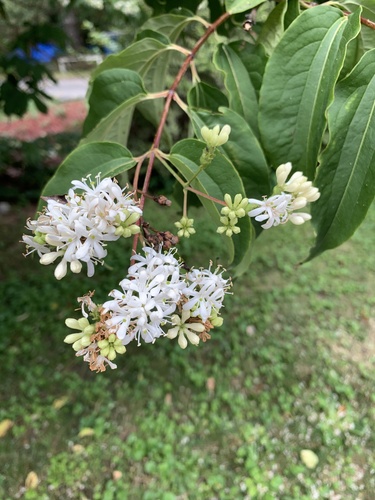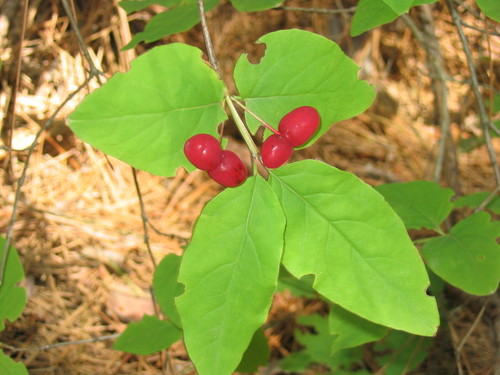
About Lonicera canadensis Bartram ex Marshall
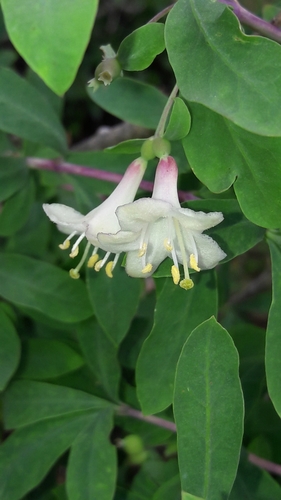
Lonicera canadensis, commonly known as American fly honeysuckle or Canada fly honeysuckle, is a deciduous, perennial, phanerophytic, monoclinous flowering shrub that grows 1 to 2 meters (3 feet 3 inches to 6 feet 7 inches) tall. It typically flowers from the last week of April through the third or fourth week of May. Fruit develops from approximately the first week of June until the first week of August. A variety of avian frugivores feed on its fruit, including the American robin (Turdus migratorius) and the northern cardinal (Cardinalis cardinalis). Its seeds can remain viable after several years of dry storage at room temperature.
This species grows in habitats ranging from dry to moist upland woods; it is occasionally found in coniferous swamps and growing along streams. Its main stems have light brown, round, fibrous or furrowed bark that does not exfoliate, and main stems grow either ascending or erect. Its branches grow either ascending or horizontal.
It is native to northeastern North America. In the United States, it is recorded from Connecticut, Georgia, Iowa, Illinois, Indiana (questionably recorded), Kentucky (questionably recorded), Massachusetts, Maryland, Maine, Michigan, Minnesota, North Carolina, New Hampshire, New Jersey, New York, Ohio, Pennsylvania, Tennessee, Virginia, Vermont, Wisconsin, and West Virginia. In Canada, it occurs in New Brunswick, Nova Scotia, Ontario, Prince Edward Island, and Quebec.
Its global conservation status rank is G5. It has legal protected status in multiple U.S. states: it is listed as Extirpated in Indiana, Endangered in Maryland and New Jersey, and Special Concern in Tennessee. Its wetland indicator status is FACU (Facultative Upland): it usually occurs in non-wetlands, with an estimated 67%–99% probability of occurrence in non-wetlands, and is only occasionally found in wetlands, with an estimated 1%–33% probability of occurrence in wetlands.