About Lonicera caerulea L.
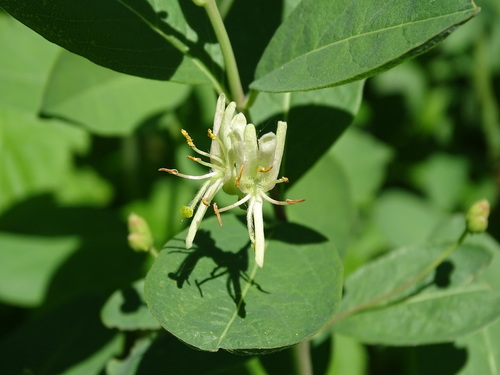
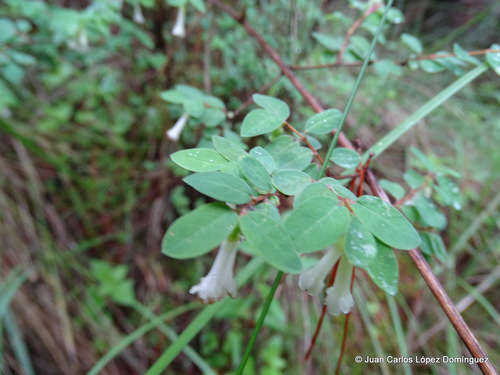
Lonicera caerulea L., commonly called haskap or honeyberry, is a deciduous shrub that grows 1.5 to 2 meters (4 feet 11 inches to 6 feet 7 inches) tall. Its leaves are arranged opposite each other, oval in shape, 3 to 8 centimeters (1.2 to 3.1 inches) long and 1 to 3 centimeters (0.39 to 1.18 inches) broad. The leaves are greyish green with a slightly waxy texture. The yellowish-white flowers are 12 to 16 millimeters long with five equal lobes, and they grow in pairs on the plant’s shoots. The fruit is an edible, blue, somewhat cylindrical berry that weighs 1.3 to 2.2 grams (0.046 to 0.078 ounces), and measures about 1 centimeter (0.39 inches) in diameter. This plant is winter-hardy, and can tolerate temperatures below −47 °C (−53 °F). Its flowers are also frost-tolerant. Fruits mature early and are high in vitamin C. Haskap cultivars can survive a wide range of soil acidity from pH 3.9 to 7.7, with optimum growth between pH 5.5 and 6.5. For best productivity, the plant requires high organic matter, well-drained soils, and plentiful sunlight. Lonicera caerulea plants are more tolerant of wet growing conditions than most other fruit species. The chromosome count for this species is 2n = 18. This species has a circumpolar distribution, and is primarily found in or near wetlands of boreal forests growing in heavy peat soils across North America, Europe, and Asia. It can also grow in high-calcium soils, in mountain regions, and along the coasts of northeastern Asia and northwestern North America. Different varieties of this species are distributed across central and northern Canada, the northern United States, northern and eastern Europe, Siberia, middle Asia, and northeastern China. Indigenous peoples of eastern Russia, northern Japan, and northern China have harvested the wild berries of this species for a long time, but formal cultivation efforts are relatively recent. Research focused on commercial cultivation improved in Hokkaido, Japan in the 1970s. The plant remains mostly unknown in the Western world, even though some varieties already grow in Canada and the northern United States. The haskap variety Lonicera caerulea var. edulis has been used frequently in breeding work, and has been crossed with other varieties to boost productivity and improve flavor. In many haskap breeding programs, the variety Lonicera caerulea var. emphyllocalyx has been the dominant type used. In recent years, a new program has been established to grow honeyberries commercially in Scotland, which has a similar climate to Japan; commercial growing trials take place at farms in Duns, Angus, Tayside, Perth and Fife. Harvest timing varies by variety: Russian-type haskap varieties are harvested in late spring or early summer, two weeks before strawberries, while Japanese-type varieties ripen around the same time as strawberries. Berries are ready to harvest when their inner flesh is dark purple or blue; the outer skin may appear dark blue and ripe even when the inner flesh is still green and sour. Two compatible varieties are required for cross pollination and successful fruit set. In North America, most Russian varieties are adapted to hardiness zones 1 to 4. Plants typically take three or four years after planting to produce an abundant harvest. A well-grown mature bush produces an average of about 3 kilograms (6.6 pounds) of fruit, and healthy bushes can maintain consistent productivity for up to 30 years. Haskap berries can be used to make a range of processed products, including pastries, jams, juice, ice cream, yogurt, sauces, candies, and a wine that is similar in color and flavor to red grape or cherry wine. Over centuries in East Asian countries, Lonicera caerulea has been used for supposed therapeutic applications in traditional medicine.