About Lonicera acuminata Wall.
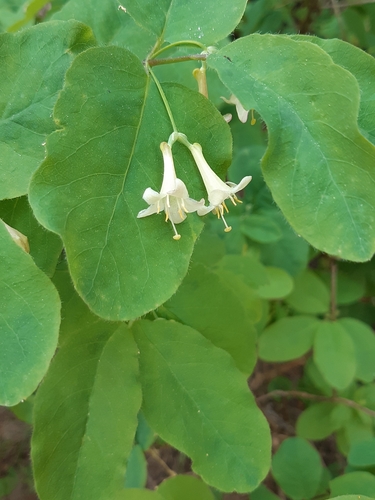
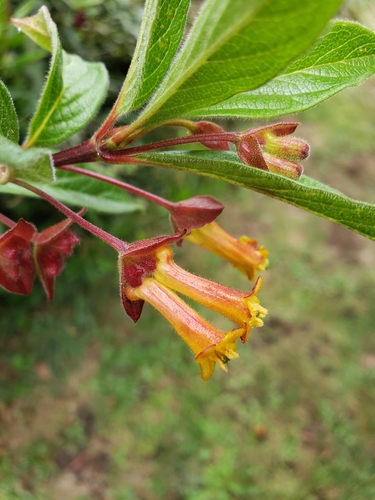
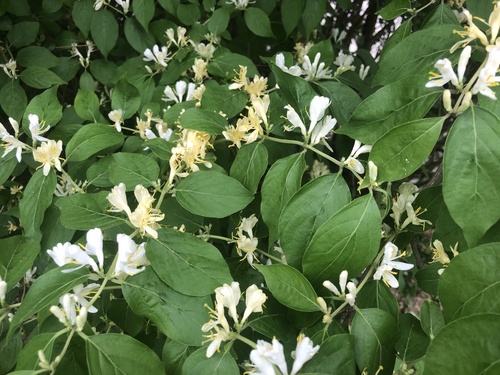
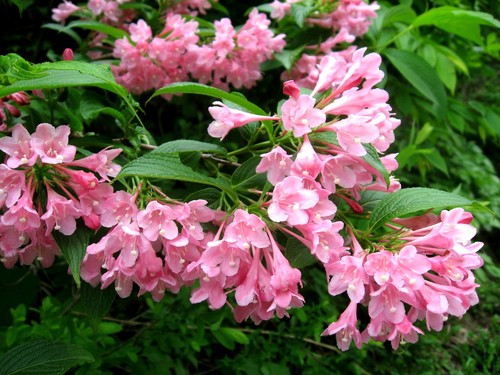
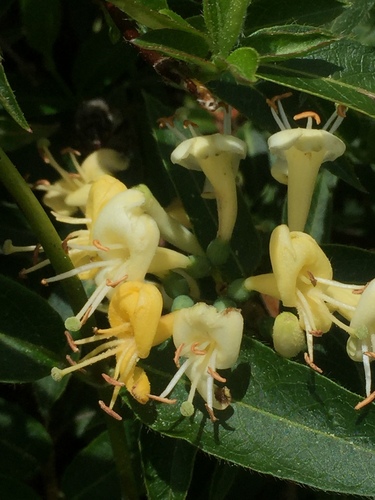
Lonicera acuminata Wall. is a semi-evergreen, fast-growing lignifying vine that reaches several meters in height. Most branches, petioles, and peduncles are hairy, and mature branches typically become hollow. Its simple leaves are short-stalked with entire margins; they are most often opposite, and sometimes arranged in whorls of three. Leaves are leathery, ranging from more or less hirsute (especially along the midvein) to hairless, with often slightly ciliate edges. They measure 2.5 to 13 centimeters long and 1.3 to 4.5 centimeters wide, with shapes ranging from ovoid to lanceolate, or obovate to inverted lanceolate. At the base, attached to the short 2 to 15 millimeter long petiole, leaves are pointed to rounded, and often slightly cordate; leaf apices are acuminate to caudate. To reduce water evaporation, leaves may roll inward slightly. Flowers are hermaphroditic, narrowly funnelform, five-petaled, and colored reddish to purple or yellow, with a dichlamydeous perianth. They most often grow in stalked pairs, and more rarely form small panicles, growing axillary at branch apices. Flowers have both bracts and bracteoles. The small calyx is pitcher-shaped with small teeth, and the corolla is double-lipped, with a recurved, tongue-shaped lower lip. The long corolla tube is more or less hairy on the inside. The ovary is inferior, topped with a long, firm, more or less hairy style that ends in a large, head-like stigma. The five filaments are roughly as long as the corolla, and are partially hairy along their lower sections. Nectaries are present in flowers. This species blooms between May and July, producing fragrant flowers. In October and November, it bears roundish to ovoid, smooth blue-black pruinose berries that measure 4 to 6 millimeters across. Berries hold several seeds, and retain calyx remains at their apex. Seeds are ellipsoid to elongated, and somewhat compressed. This species grows on neutral to alkaline soils at elevations up to 3200 meters above sea level. It is native to Western China, Tibet, Nepal, Bhutan, India, and the Asian tropics. Global cultivation has led to spontaneous naturalized occurrences in other regions. In ecology, the species' nectar attracts insects and hummingbirds, while its berries attract birds. Plants can be infected by powdery mildew, and infested by aphids and thrips. Lonicera acuminata is used to create insect- and bird-friendly green walls. In the Philippines, its stems are used as binding material for fence construction. It can be propagated via cuttings, and application of the plant hormone 1-aminobenzotriazole (ABT1) improves rooting success.