About Lonchura striata (Linnaeus, 1766)
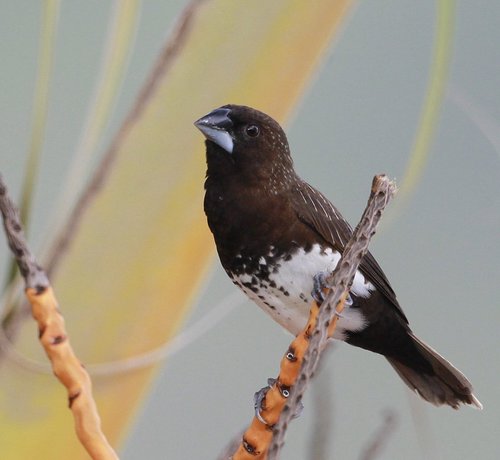
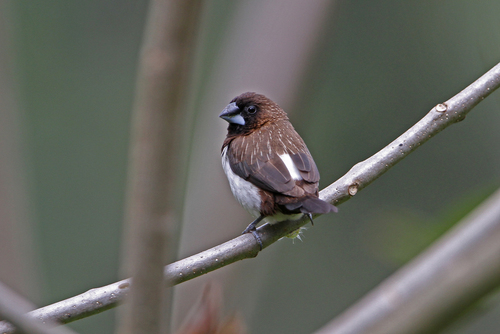
The white-rumped munia (Lonchura striata) has a length of approximately 10 to 11 centimeters, a stubby grey bill, and a long black pointed tail. Adult birds are brown on the upper body and breast, with lighter coloration on the lower body, and a white rump. Subspecies of this bird show some variation, and the sexes are almost impossible to tell apart across all subspecies, though males have a bulkier head and bill.
The white-rumped munia is a non-migratory resident breeder, with a distribution that stretches from the Indian subcontinent, through Southeast Asia, to southern China, Taiwan, and Sumatra. It frequents open woodland, grassland, and scrub, and can adapt well to agricultural land areas. It is common and widespread across its large range, so the IUCN does not classify it as a threatened species. It may become a local nuisance pest that damages millets and similar grains. Even the Nicobar Islands subspecies, which has a very limited range, appears to adapt successfully to areas with human settlement. Since the white-rumped munia is drab-colored, rather reclusive, and lives in dense undergrowth, it is not often noticeable even when present in large numbers.
This species is gregarious, feeds mainly on seeds, and moves through undergrowth in groups. It sometimes associates with other bird species, such as the puff-throated babbler (Pellorneum ruficeps). It builds its nest as a large domed structure made of grass, placed in a tree, bush, or clump of grass, and lays between three to eight white eggs per clutch. It is often observed feeding on algae near water, and researchers have suggested it gains protein from the Spirogyra algae that grows in paddy fields. The white-rumped munia also makes use of abandoned nests built by Baya weavers.