About Lonchura oryzivora (Linnaeus, 1758)
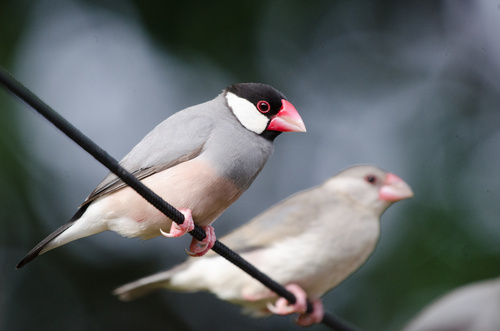
The Java sparrow, Lonchura oryzivora (Linnaeus, 1758), measures 15 to 17 cm (5.9 to 6.7 in) in total length from beak to the tip of its tail feathers. While it is only around the same size as a house sparrow, it may be the largest species in the estrildid family. Its mean body weight is 24.5 g (0.86 oz), which makes it slightly heavier than the black-bellied seedeater, its nearest known rival for size. Adult Java sparrows have a distinct, easy to identify appearance: grey upperparts and breast, pink belly, white cheeks on a black head, red eye-ring, pink feet, and a thick red bill. Males and females have identical plumage. Immature birds have brown upperparts, pale brown underparts, and a plain unmarked head. Very young individuals have a black beak with a pink base. The species' basic call is a single chip, and its song is a rapid series of repeated chip notes: chipchipchipchipchipchip. A 2018 study by Furutani et al. found that Java sparrows produce distinct trill-calls for different behavioural contexts. Though these trill-calls are acoustically similar, they differ in repetition rate based on the situation the bird is in. During aggressive interactions, Java sparrows produce faster trill-calls that have higher sound pressure levels and higher entropy. During affiliative behaviour, by contrast, their trill-calls are slower and softer. This variation in trill-calls plays a critical role in the birds' social communication, helping them convey different intentions depending on social context. The Java sparrow is a highly gregarious bird that feeds mainly on grain and other seeds. It most often lives in open grassland and cultivated areas. Historically, it was considered a pest in rice fields, which is the origin of its scientific species name oryzivora. It builds its nest in a tree or on a building, and lays clutches of up to eight eggs.