About Lonchura fuscans (Cassin, 1852)
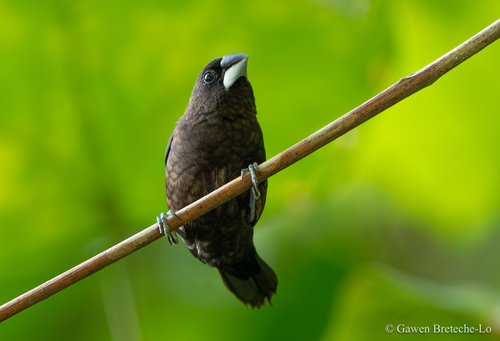
The dusky munia, Lonchura fuscans, is a small perching bird. Adult individuals reach a body length of 10 to 11 centimeters and weigh an average of 9.5 grams. This species has rich dark brown plumage, with pale brown streaks on the feathers of its crown, and blue-gray legs. It has a gray ring around the eye, dark coloring across the face, a black upper mandible on its bill, and a blue-gray lower mandible. Males and females have identical feather patterns with no distinguishing markings between the sexes. This species is evaluated as Least Concern on conservation status lists. It is most commonly found on Borneo, and also occurs in Brunei, Indonesia, Malaysia, and the Philippines. It has been introduced to the Natuna, Banggi, Cagayan and Sulu Islands. While the total population size of the dusky munia is unknown, its population growth is stable, and the species faces virtually no threats. It inhabits subtropical and tropical lowland shrubland, forest, and grassland. Its habitat varies widely, and it has been recorded in the foothills of Borneo, open grasslands, agricultural areas such as rice paddy fields, along riverbanks, in reed-beds, secondary scrub, and cultivated areas. It occurs from sea level up to 500 meters above sea level. The dusky munia is not migratory, and does not leave its habitat during seasonal changes like many other bird species. For reproduction, female dusky munias build nests from collected pieces of grass, or may reuse abandoned nests built by smaller chestnut munia birds. Nests can be built in a wide range of environments, but the species prefers dark, elevated spaces or small crevices. Nests are commonly placed in caves, holes in river banks, bushes, dense trees, hollow trees, and the roots of fallen trees. Once completed, nests are used for roosting, breeding, and egg incubation. After breeding, females lay an average clutch of 4 to 6 eggs, and clutches can be as large as 8 eggs. The average incubation period for a clutch ranges from 13 to 14 days, varying based on clutch size. After hatching, young dusky munias fledge three weeks after hatching, while still in the nest.