About Lonchura cucullata (Swainson, 1837)
Scientific name: Lonchura cucullata (Swainson, 1837)
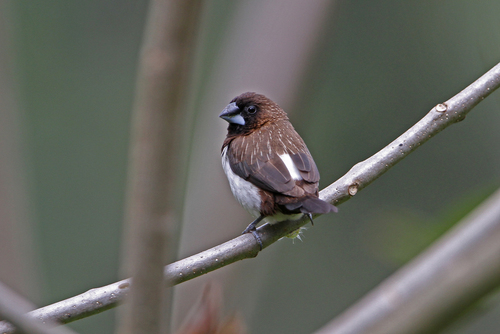
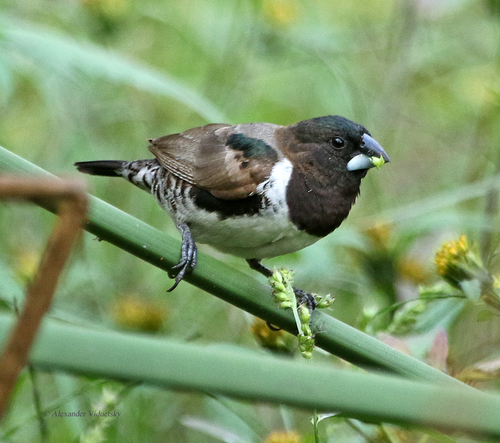
Description: The bronze mannikin is one of the smallest munia species, with a body length of 9–10 cm and a weight of 7–12 grams. Adult bronze mannikins are compact birds with a short black tail, and stubby black and pale grey mandibles that are not distinctly bluish. Their head, chin, throat, and center of the chest are black to brownish black, with purple-green iridescence on the face and sides of the breast. They have greyish brown upper body parts and white underparts, with irregular barring on the flanks and rump. A small patch of green iridescence appears on the outer scapular feathers, and this patch also occurs on the sides of the lower breast, especially in the western race. Wing coverts and remiges have paler or warmer colored borders. The sexes have similar plumage. Immature bronze mannikins are dun brown on their upper bodies, with buff colored plumage on the head and underparts. They molt into full adult plumage by six months of age; at this age, males also begin singing and exhibiting breeding behavior. The subspecies S. c. scutata has barred plumage, rather than bronzy green plumage, at the junction of the lower breast and flanks. Its rump and upper tail feathers are only finely barred and almost uniformly dark. These distinguishing traits are somewhat variable and unpredictable, however. This species produces a range of calls: a rreep-rreeep call when in flight, and twittering when perched made up of various wheezy or buzzing notes. Its song is a linked, somewhat repetitive series of notes.
Distribution and habitat: The bronze mannikin is native to mainland Africa, plus the islands of Bioko, Pemba, Zanzibar, Mafia, and the Comoros. It has been introduced to Puerto Rico, where it has an established population. The two accepted subspecies have an extensive region around the upper Nile River that is inhabited by birds with intermediate features. A proposed third subspecies, S. c. subsp. tressellata Clancey, 1964, is not generally recognized by the scientific community.
Behaviour and ecology: The bronze mannikin is a tiny, gregarious bird that feeds mainly on seeds, including wild grass seeds, millet, rice, and grain. It may also eat termites, nectar, or strands of algae. Before roosting at nightfall, bronze mannikins usually visit a watering hole where vegetation hangs into the water. They roost overnight in ball-shaped nests, which are built only for roosting during the non-breeding season. These unkempt communal roosting nests are dismantled to reuse nesting material, and rebuilt almost daily either at the same location or a new location, through a communal effort. Each roosting group, which numbers 8 to 20 birds, appears to be dominated by a single adult male. The flock defends the area immediately around the nest against intruders, but newcomers to the flock are easily accepted. Bronze mannikins may associate with waxbills or other mannikin species, and may also use nests vacated by these other species. Breeding pairs often engage in allopreening.