About Lonchura castaneothorax (Gould, 1837)
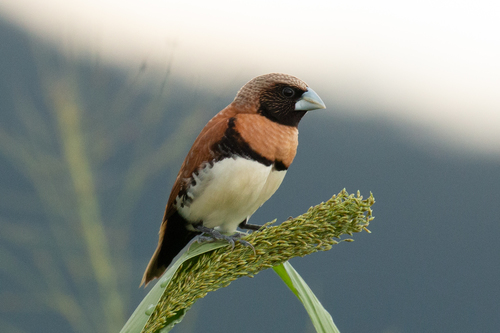
The chestnut-breasted mannikin, scientifically named Lonchura castaneothorax (Gould, 1837), is also called the chestnut-breasted munia, or the bully bird in Australia. It is a small munia with a brown back, black face, and greyish crown and nape. It has a broad ferruginous breast bar above a white belly. The species’ natural range covers Australia, Indonesia, and Papua New Guinea, and it has been introduced to French Polynesia and New Caledonia. In Australia, the chestnut-breasted mannikin inhabits reed beds, rank grasses along river borders, swamps, grassy country, mangroves, and grassy woodland. It is commonly found in cane fields and cereal crops. During the dry season, it occurs in arid country but always stays close to water. John Gould, quoted in Cayley 1932, noted that he never encountered this bird in the wild, but was told it frequents reed beds bordering river banks and lagoons on Australia’s eastern coast. He added that it resembles the European Bearded Tit Panurus biarmicus in its agility moving up and down upright reed stems from base to top, a habit well-suited to its elongated, curved claws. In New Guinea, the chestnut-breasted mannikin lives in drier areas, and is not usually found in jungle roads and clearings where other munias like the grey-headed mannikin occur. As an introduced, well-established species in French Polynesia, the chestnut-breasted mannikin has developed slightly different habits that show the species’ adaptability. Unlike in Australia, it is widespread on bracken-covered hill slopes, pastures, gardens, cultivated land, wasteland, forest ecotones, and coconut plantations (Lever 1989). In Australia, chestnut-breasted mannikins are mostly seen in pairs during the breeding season. In late autumn and winter, they congregate in large flocks, and sometimes feed on cereal crop seeds. This is a highly sociable species, forming large flocks outside the breeding season. Breeding individuals will join groups or flocks while foraging. It has a clear preference for barley seed, so local people call it the “barley bird”. It also favors paspalum grass (Paspalum longifolium), bullrush millet (Pennisetum typhoides), and Sorghum species. In Papua New Guinea, it has been recorded feeding on feral millet Pannicum maximum and wild sugar cane Saccharum robustum (Bapista 1990).