About Lonchura bicolor (Fraser, 1843)
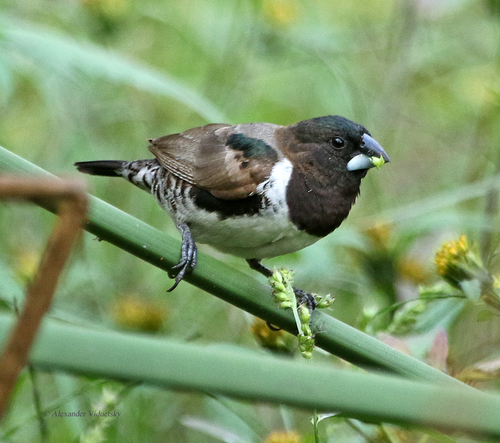
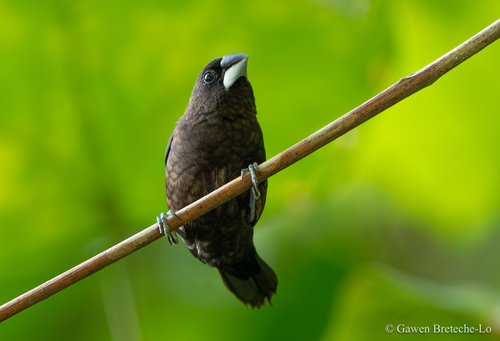
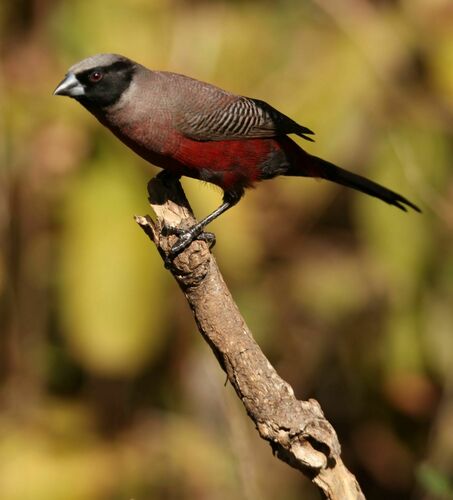
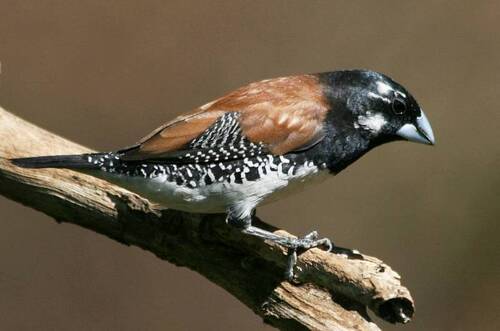
The black-and-white mannikin, also called black-and-white munia or red-backed mannikin, is a species of estrildid finch that is widely distributed across sub-Saharan Africa. It has an estimated global extent of occurrence of 4,200,000 km² (1,600,000 sq mi), and inhabits moist savanna and subtropical or tropical moist lowland forest. This species is currently evaluated as least concern on conservation status assessments. While primarily seedeaters, black-and-white mannikins are also known to feed on algae. This species was formally described in 1843 by British zoologist and collector Louis Fraser, from a specimen collected near Cape Palmas in Liberia. Fraser originally placed the species in the genus Amadina, and created the binomial name Amadina bicolor. Today, the black-and-white mannikin is one of four species classified in the genus Spermestes, which was introduced in 1837 by William Swainson. Four subspecies are currently recognised: S. b. bicolor (Fraser, 1843), found from Guinea-Bissau to Cameroon; S. b. poensis (Fraser, 1843), found from south Cameroon to south Sudan, southwest Ethiopia, west Kenya, and the island of Bioko; S. b. woltersi (Schouteden, 1956), found in southeast Democratic Republic of the Congo and northwest Zambia; and S. b. nigriceps Cassin, 1852, found from central Kenya and south Somalia to east Angola, Zambia, Zimbabwe, and east South Africa. The subspecies S. b. woltersi and S. b. nigriceps have sometimes been treated as a separate species called the red-backed mannikin.