About Lomographa bimaculata (Fabricius, 1775)
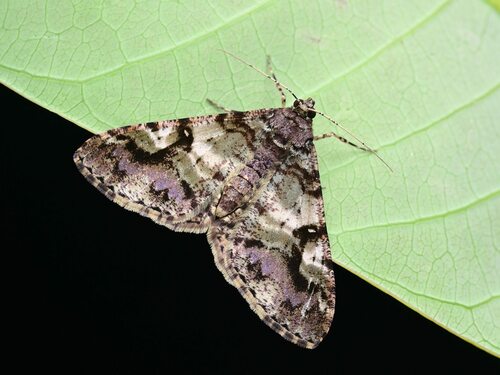
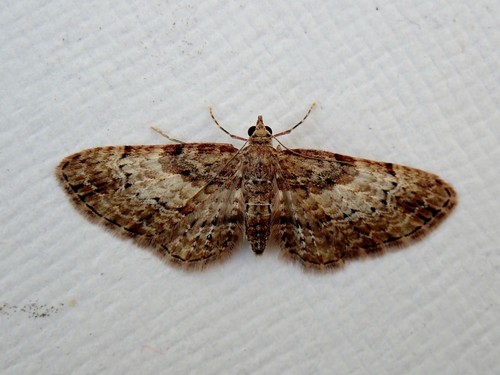
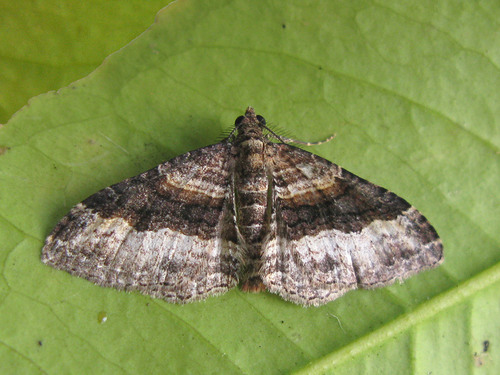
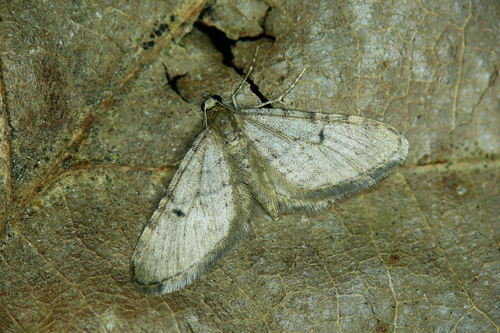
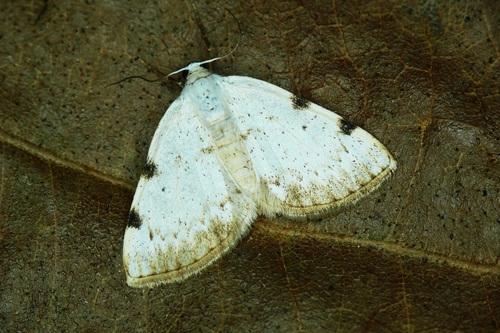
This rather common moth species mainly inhabits woodland areas, and is found across central and eastern Europe. It is absent from the Balkans between Bosnia-Herzegovina and Greece, and is also not found in Iceland. It is rare at the periphery of its range: for example, it only occurs locally north of the English Midlands and in Ireland. To the east, its distribution extends through the Caucasus, Russia, the Russian Far East, Siberia, and Central Asia to Japan. In the Southern Alps, the species only occurs at lower altitudes. It prefers bushy deciduous forest edges, forest clearings, river banks, gardens, and parks. In the British Isles, adults usually emerge in early summer, though exceptional later sightings have been recorded: for example, the species was observed in Germany in early August 1938. Adults are primarily nocturnal and can be attracted to light. The adult wingspan measures 22–26 mm. The wings are a very pale silvery grey, with two dark grey spots on the leading edge of each forewing. From these spots run the two bands typical of Ennominae, which in this species consist only of very small, faint grey speckles, that extend across the forewings and hindwings to form a semicircle. The body is also whitish. The rounded egg is strongly depressed. Mature caterpillars are green, and can be recognized by a purple-brown or red dorsal line that is mostly interrupted, with diamond spots especially towards the end. The pupa is reddish-brown, with two tips and several short bristles on the cremaster. This species usually produces one generation per year, though late sightings indicate this is not always the case. Caterpillars feed on Prunus species, including bird cherry (Prunus padus) and blackthorn (Prunus spinosa), as well as on hawthorns (Crataegus).