About Lomelosia graminifolia (L.) Greuter & Burdet
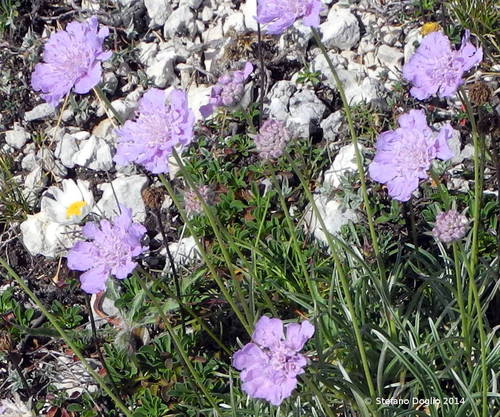
Lomelosia graminifolia, also known by the synonym Scabiosa graminifolia and the common name grass-leaved scabious, is a species of the genus Lomelosia. It is native to the Mediterranean region, ranging from Morocco and Spain to Greece, and grows on rocky slopes. As its common name suggests, this species has grass-like leaves. Its pink or lilac flowers open in summer.
Lomelosia graminifolia is primarily a south-European montane species, and is most frequent on the sunny limestone flanks of the southern and south-western Alps. It is native to Morocco, and has been recorded from Albania, France, Greece, Italy, Spain, Switzerland, and former Yugoslavia. In Slovenia, it reaches the north-eastern edge of its full overall range. A 2020 survey found around twenty scattered plants across five micro-sites in the Trenta Valley of the Julian Alps, at an altitude of 520–810 m.
These individual plants grow on narrow screes and gravelly ledges within the Sravnik ravine, or on immediately adjacent rocky slopes. In this area, only a thin layer of soil covers fractured limestone or dolomite. At the Trenta Valley sites, the species grows in two different, but equally open, plant communities. On mobile scree, it is a minor component of the Stipetum calamagrostis grassland, which is dominated by the needle-grass Achnatherum calamagrostis. On slightly more stable substrate, the species co-dominates a newly described plant community: Aquilegio einseleanae–Caricetum mucronatae. This community grows on shallow lithosols that also support Carex mucronata, Globularia cordifolia, and the eastern-Alpine columbine Aquilegia einseleana.
Both of these plant communities are south-facing, dry, and low in nutrients. These conditions restrict the growth of tall competing plants, and favour drought-tolerant perennials such as L. graminifolia. Outside of the Julian Alps, this species is only found in a small number of calcareous localities in Slovenia: on the Soča River terraces near Solkan, the Nanos and Trnovski Gozd plateaux, and the slopes of Mount Snežnik. It has never been recorded in Austria. These outlying Slovenian populations, along with the newly documented Trenta Valley stands, confirm that the species can survive on very young, skeletal soils, as long as slope aspect and drainage match the warm, rocky hillside habitats that are typical of its core distribution further west.