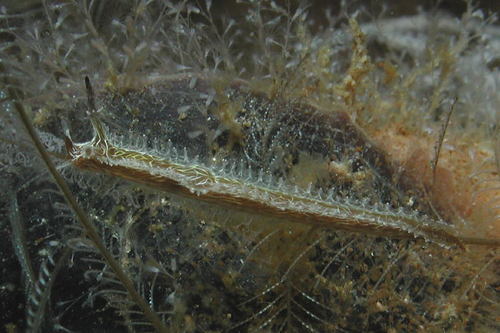
About Lomanotus vermiformis Eliot, 1908
Lomanotus vermiformis has a very elongated and narrow body. Its rhinophoral sheaths bear papillae, and extend upwards to cover three quarters of the rhinophores. Its cerata are very short and pointed. The species' body background color is brown, marked with dark brown spots, opaque yellow lines, and opaque white reticulations across the entire body. The maximum recorded body length of this species is 40 mm, and most individuals are smaller than 25 mm. Lomanotus vermiformis has a circumtropical distribution. It was first described from specimens collected in the Red Sea, and has been widely reported from tropical seas throughout the Indo-Pacific region. In the Western Atlantic, it has been recorded from Florida, the Bahamas, and Panama. This species occurs at depths between a recorded minimum of 1 m and a recorded maximum of 4.5 m. It feeds on the common stinging hydroid Lytocarpus philippinus, hydroids belonging to the genus Macrorhynchia, and an unidentified hydroid species in Panama, where it is extremely cryptic on its prey. When disturbed, Lomanotus vermiformis can swim by making lateral flexions of its body.

