About Lomandra longifolia Labill.
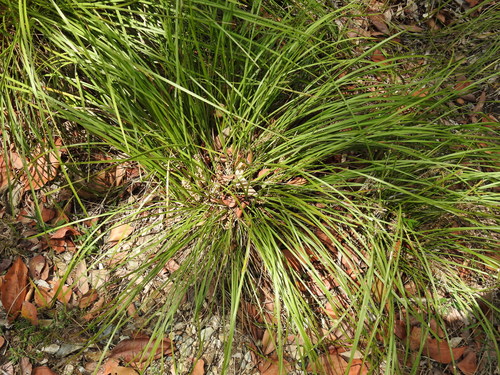
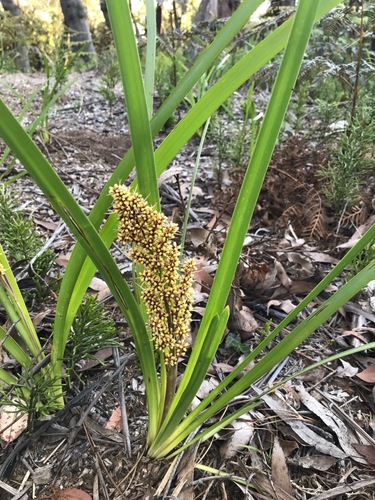
Lomandra longifolia Labill., commonly called spiny-head mat-rush, spiky-headed mat-rush, or basket grass, is a perennial, rhizomatous herb native to eastern Australia. Its leaves are typically 40 cm to 80 cm long, and generally 8 mm to 12 mm wide. This species grows in a wide range of soil types, and is tolerant of frost, heat, and drought. Jacques Labillardiere described Lomandra longifolia from a specimen collected in Tasmania. Lomandra longifolia is native to eastern Australia, and is common in all Australian states and territories except the Northern Territory and Western Australia. This strappy-leaved plant is widely used in landscaping in Australia, New Zealand, Spain, and the United States, valued for its high drought tolerance. Breeding of more compact varieties with finer leaves has made Lomandra longifolia popular as an evergreen grass-like plant for home plantings. The cultivar Tanika, formally Lomandra longifolia 'LM300', is called breeze grass in the United States, and was the first fine-leaved type developed. It still has the finest leaf of any Lomandra longifolia, measuring just 3 mm wide. This variety remains evergreen in temperatures as low as −7 degrees Celsius, and has been recorded surviving at −10 degrees Celsius at sites in Alabama, USA. Lomandra longifolia is closely related to Lomandra hystrix; the main difference between the two is in leaf structure. The leaf of L. hystrix has teeth along each side that are shorter than the longer central leaf tip, while the side teeth on L. longifolia leaves are equal to or longer than the central tip, forming a W shape. Many parts of Lomandra longifolia are edible. The raw seeds are tough, but they can be ground into flour that Indigenous Australians have traditionally used to make damper. The long, flat, fibrous leaves are used for weaving dilly bags, fishing nets, mats, baskets, and other items. The flowers are edible and have a pea-like flavor. The base of the leaves holds water, and was chewed by people at risk of dehydration. The leaf bases have a flavor similar to peas or celery.