About Lomandra effusa (Lindl.) Ewart
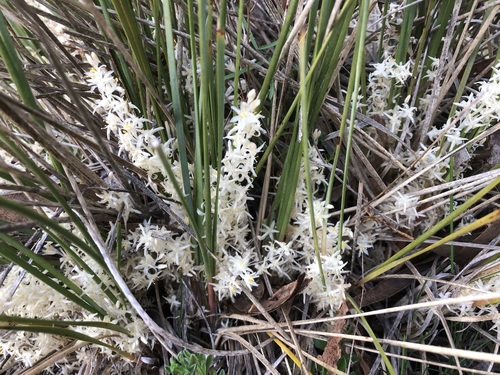
Lomandra effusa (Lindl.) Ewart is a native Australian grass-like perennial tussock herb. It can grow up to 50 cm in both height and width, and reaches maturity in 2.5 years. It consists of long, flat, arching leaves 10–50 cm in length and up to 2 mm wide. Each leaf tip tapers to form two points, which is a key distinguishing feature of this species. The leaves are strong and tough, with a bluish green or grey colour. The base of the plant is brown and fibrous. Its inflorescence is most similar to that of its relative Lomandra marginata, which also has white flowers. Lomandra effusa is dioecious: male and female reproductive organs occur on separate plants, with each plant producing only male or only female flowers. Flowers are funnel-shaped, and can be white, cream, or pink, with a strong fragrance. Flowering occurs in winter and spring, from June to October, following rain. Male and female flowers are grouped on branches 3–15 cm long, with pedicels up to 1 cm. Flowering branches are roughly one third the length of the leaves. Each flowering branch has a non-flowering axis 1–2.5 cm long, and a flowering axis 4.5–10 cm long. Bracts are pale brown to translucent, and are often longer than the pedicel. Male flowers generally have a narrow perianth and narrow tepals. Female flowers have a broader perianth, broad-based tepals, shorter pedicels, stiffer segments, and a thicker, broader base than male flowers. Lomandra effusa is native to Australia, where it is found in the states of Victoria, South Australia, southern Western Australia, the Australian Capital Territory, and New South Wales. It occurs from the Australian coast to the mountains. In Victoria, it is found in the Wimmera, Goldfields, Dundas Tablelands, Northern Inland Slopes, Greater Grampians, Volcanic Plains, Robinvale Plains, and Riverina IBRA bioregions, as well as Murray regions, and Mallee communities. Across the Murray regions it also occurs in Western Australia and South Australia. In South Australia, it is also found in the Nullarbor, Gairdner-Torrens, Eyre Peninsula, Yorke Peninsula, Flinders Ranges, Eastern, South Eastern, North Lofty, and South Lofty bioregions and communities. In New South Wales, it occurs in subdivisions west of Condobolin. In Western Australia, it is found in the Eremaean and South-West regions, specifically in the Avon Wheatbelt, Coolgardie, Northern Jarrah Forest, Eastern Murchison, Yalgoo, Esperance Plains, Swan Coastal Plain, and Geraldton Sandplains subregions. This species grows on lake slopes, dunes, well-drained flats, near salt pans and granite outcrops. It is the dominant species in the Lomandra effusa tussock grassland ecological group, which is most often found on hill slopes in the east and south and in Lofty communities. It can also be the dominant or co-dominant species in the Lomandra effusa and Lomandra multiflora tussock grassland ecological group, which is often found on hill slopes and plains in the east. Inflorescence develops after rain, with flowering falling between June and October, in winter and spring. Lomandra effusa tolerates harsh conditions including drought and moderate to heavy frost. It prefers full sun, and tolerates partial shade, particularly in hotter, harsher areas. It tolerates lime, most soil types, neutral or acidic soil pH, and occasionally alkaline soil. It grows best in well-drained soils that are sandy, loam, clay, sometimes heavier soils, or ironstone gravel, and is often found near salt pans or granite outcrops in a variety of vegetation types. Within tussock grassland communities where it occurs, it is often dominant or co-dominant alongside its close relative Lomandra multiflora. It is also frequently accompanied by other native perennial flora, particularly other tussock grasses of similar size. Tussock grasslands containing Lomandra effusa grow in areas with 5% to 70% canopy cover, and undergrowth coverage can reach up to 70%. Lomandra effusa contributes the characteristic tussock structure to these ecological communities. As a native Australian species, it remains resilient to invasive species in its natural ecological communities. It forms habitat that provides protection for many small native animals, including mammals and reptiles. It can be a food source for some herbivores and seed-eating native birds, and its fragrant flowers are a food source for butterflies and their larvae. Its tough, fibrous leaves and two-pointed tips make it less digestible for large livestock, so it is only grazed by livestock in particularly poor years. This means it is less affected by grazing pressure than many other grasses. Plants of the Lomandra genus are often used for commercial and domestic purposes. Some species are used for food, as a source of food, for ornamental purposes, as bush medicine, or for erosion control via mass planting. For commercial use of Lomandra species, uniform high-volume production via plant tissue culture is required. Lomandra effusa can be propagated by seed, or by root division of existing clumps. To regenerate the plant, untidy foliage can be cut back, and old tussocks can be burned. Seeds take 2 to 12 weeks to germinate. For cultivation, the plant requires well-drained soil, full sun or partial shade in particularly hot areas, and winter mulch in particularly cold areas.