About Loligo vulgaris Lamarck, 1798
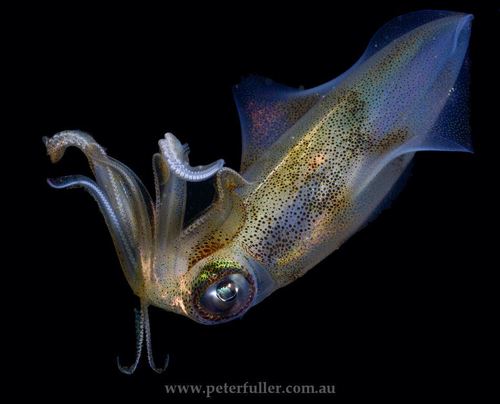
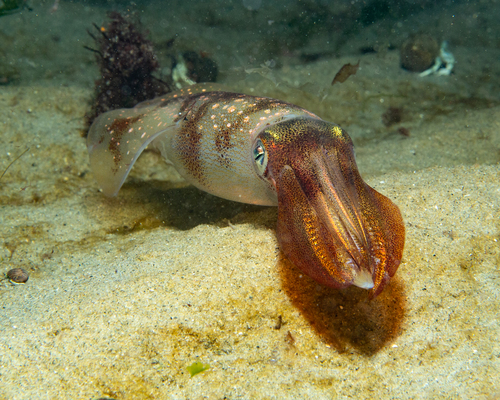
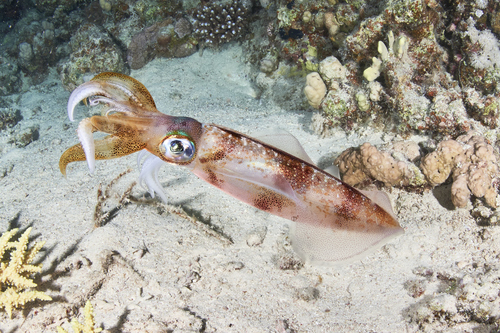
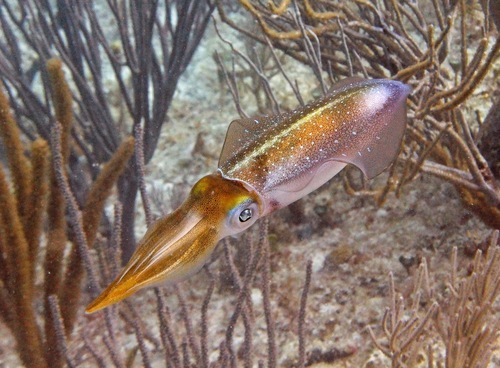
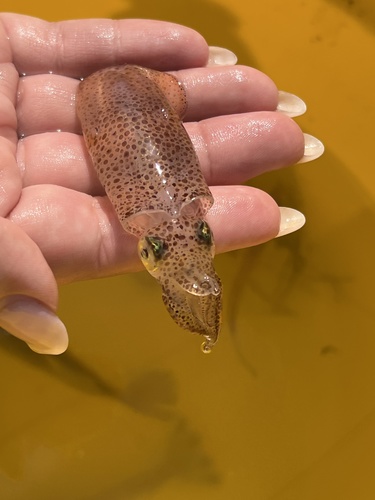
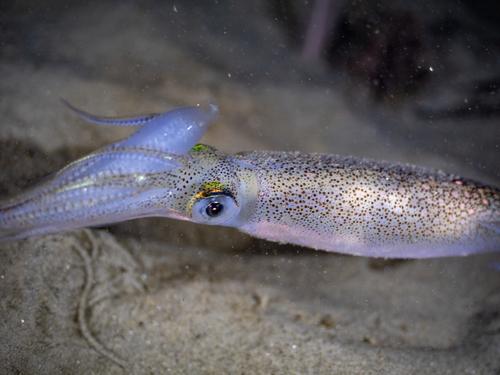
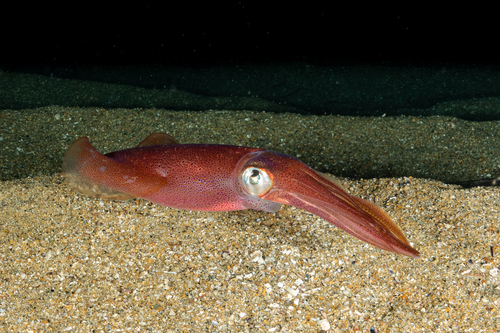
Loligo vulgaris, commonly known as the European squid, has a long, moderately slender cylindrical body. Its rhomboid fins make up two-thirds of its mantle length, though the species moves using jet propulsion. The posterior border of the fins is slightly concave. It has a relatively small head with large eyes covered by a transparent membrane. Like almost all squid, this species has ten limbs surrounding its mouth and beak: eight are shorter arms, and two are longer tentacles used to catch prey. In males, the fourth left arm is modified into a hectocotylus. European squid can reach a mantle length of 30 to 40 cm, but most individuals measure 15 to 25 cm in mantle length. Males are typically larger than females and grow more quickly. Their body colour ranges from greyish-transparent to reddish, a change that depends on the expansion of chromatophores located in the dermis. Males have small chromatophores on their mantle. European squid is a neritic, semidemersal species that carries out distinct horizontal and vertical migrations based on environmental conditions. In the Adriatic Sea, it occurs over a range of substrates, from sandy to muddy bottoms. It lives in waters between 13°C and 20°C, and prefers temperatures of 18°C. Loligo vulgaris occurs throughout the Mediterranean Sea and the eastern Atlantic Ocean from the North Sea south to the Gulf of Guinea. In British waters, it is found primarily in the Irish Sea, along the south coast of England, and off northern Scotland.