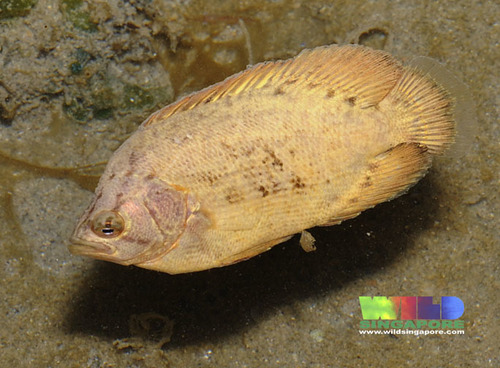
About Lobotes surinamensis (Bloch, 1790)
The Atlantic tripletail, with the scientific name Lobotes surinamensis (Bloch, 1790), has an oval to rhomboid-shaped, compressed body. It has a slightly concave forehead, and its upper jaw can be protruded a short distance. Each jaw holds an outer row of small, densely packed canine-like teeth, plus an inner band of smaller teeth, but there are no teeth on the roof of the mouth. The preoperculum is serrated; as the fish ages, the serrations get smaller and grow more numerous, while the operculum has two flat, hidden spines. The single continuous dorsal fin is supported by 12 strong spines and 15 or 16 soft rays, and the anal fin contains 3 spines and 11 soft rays. The soft-rayed sections of the dorsal and anal fins are tall and rounded, and they extend past the caudal peduncle, creating the appearance of three symmetrical caudal fins. The actual caudal fin is rounded. Adult Atlantic tripletails are dark brown or greenish yellow on their upper body and head, and greyish silver on their lower body. Their pectoral fins are pale yellow, while all other fins are darker than the body. The caudal fin has a yellow margin. The maximum published total length for this species is 110 cm (43 in), with a maximum recorded weight of 19.2 kilograms (42.5 lb), and the typical total length is 80 cm (31 in). Juveniles have mottled bodies patterned with a mix of yellow, brown, and black. In terms of geographical distribution, the Atlantic tripletail is the only species from the family Lobotidae found in the Atlantic Ocean. It is distributed across tropical seas, and is especially common in the Indonesian region; it is regularly seen in wet markets such as those in Pontianak, West Kalimantan. In United States waters, it occurs from Massachusetts and Bermuda south to Argentina. It is also found in the eastern Atlantic and Mediterranean Sea, from Madeira Island to the Gulf of Guinea, in the eastern Pacific from Costa Rica to Peru, and in the western Pacific from Japan to Fiji and Tuvalu. It is rarely found north of Chesapeake Bay. On the U.S. Gulf Coast, it is present from April to October, then migrates to warmer waters for winter. In spring, Atlantic tripletails concentrate just offshore of two specific locations: Port Canaveral, Florida from March to June, and Jekyll Island, Georgia from April to July. Individual Atlantic tripletails have also been recorded as far north as the United Kingdom. Atlantic tripletails live in coastal waters across most but not all tropical and subtropical seas. They are semimigratory and pelagic. While they are normally solitary, they have been observed forming schools. During the summer, they can be found in bays, sounds, and estuaries. Juveniles usually swim under patches of Sargassum algae. In the Gulf of Mexico, adults are most often found in open water, but they also occur in passes, inlets, and bays near river mouths. Large adults are sometimes found near the surface over deep, open water, though they are always associated with floating objects. Young fish are also often found in or near shipwrecks, structural beams and supports, jetties, floating flotsam, and sea buoys. Fry are typically found in waters warmer than 84 °F (29 °C), with salinity greater than 3.3‰, and at depths over 230 feet (70 m). Atlantic tripletail are well known for their unusual behavior of floating just beneath the water surface with one side exposed, mimicking a floating leaf or debris. They are also able to change their coloration between light and dark shades of their usual color. These behaviors likely help juvenile fish avoid predators, and are also thought to act as a feeding strategy. Tripletail position themselves near flotsam rafts, buoys, channel markers, crab trap floats, and other floating structures that attract and hide prey species. By floating on their side, they can blend in with this surrounding cover, letting them approach close enough to ambush and catch prey. This unique behavior has led to a quickly growing popularity of recreational sight-fishing for floating Atlantic tripletail. As a result, Florida and Georgia have put strict bag and length limits in place to protect the species' future populations. Spawning for Atlantic tripletail takes place primarily in summer along both the U.S. Atlantic coast and the U.S. Gulf of Mexico coast, with spawning peaking in July and August. This species spawns in open water, and peak spawning falls within the summer months. A single female can produce up to 700,000 eggs per spawning event; the eggs are pelagic and buoyant. The larvae are planktonic and go through major morphological changes before they settle to the substrate. Males reach sexual maturity at a smaller size and younger age than females. The large summer gatherings of Atlantic tripletail in inshore and nearshore waters off coastal Georgia indicate that this area is a critical estuarine spawning habitat for the species. Larval Atlantic tripletails develop through four distinct stages: preflexion, flexion, postflexion, and transformation. By the time larvae reach 0.16 in (4 mm) in length, they already have large eyes and concave heads. Atlantic tripletail larvae look very similar to the larvae of other fish species including boarfishes, some jacks, spadefishes, and bass.

