About Lobostemon belliformis Buys
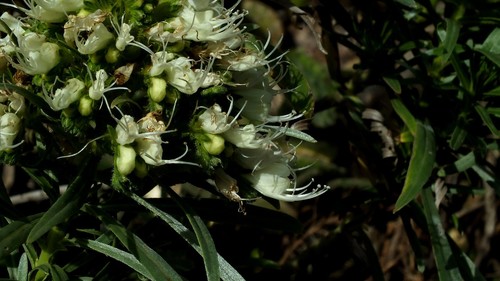
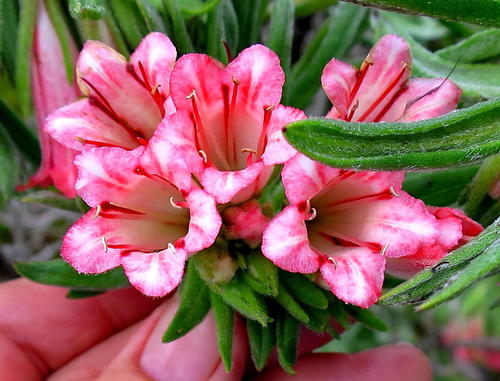
Lobostemon belliformis Buys is a woody shrub with a thick basal trunk. It branches freely, forming a rounded bright green mound, reaching 1–1.5 m (3.3–4.9 ft) in height and around 2 m (6.6 ft) in width. Its herbaceous branches are covered in hairs. Its leaves are long, oval-shaped, covered in hairs that give them a rough texture. This species produces large tubular pink or red flowers that flare wider at the mouth before opening; petals measure approximately 44–45 mm (1.7–1.8 in) in length, and the outward-facing sides of the petals are covered in hairs. Flowers are borne in cymes at the ends of branches between July and October. The stamens are slightly different in length. Staminal scales are inserted well below the throat of the corolla tube, 3 mm (0.12 in) above the base, reduced to swellings and lacking lateral lobes. It produces four small spiny-tipped nutlet seeds. This species is documented from the Gourits River. It currently has a highly restricted range, known only from one small sandstone outcrop on the Riversdale Plain; historically, it was also found on coastal limestone. It appears to be a slow-growing species that survives fires by growing on rocky outcrops and having thick bark. Its expected generation time is around 40 years, which is long for a fire-dependent ecosystem where this species lives. Over time, plants become increasingly woody and produce fewer flowers. They re-seed in large numbers after fire, and some moderately undamaged shrubs may also resprout after fire. Its flowers attract birds and bees, specifically the orange-breasted sunbird, the lesser double-collared sunbird, and the cape sugarbird. Due to its rarity, this species is generally not as commercially available as other species in the Lobostemon genus. It grows best in well-drained sandy soil in warm, sunny locations, particularly on embankments and in rockeries. It requires protection from frost and is not cold-tolerant. If plants start to lose leaves and die back, pruning back around one-third of the plant may encourage resprouting from older wood, especially when additional compost is added. It can be grown from cuttings or seeds. Tip branch cuttings do not root well, so cuttings should instead be taken from spindly side shoots resprouting from older wood, ideally in spring or autumn. Cuttings must not be kept overly wet, as they rot easily. Fresh seeds are collected when old flower heads turn brownish-grey, and should be pretreated with hot water and smoke to simulate fire to improve germination.