About Lobivia backebergii (Werderm.) Blatt.
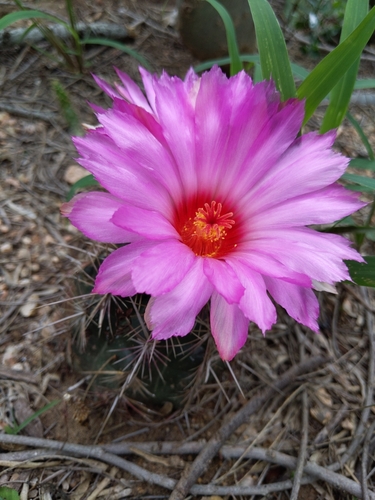
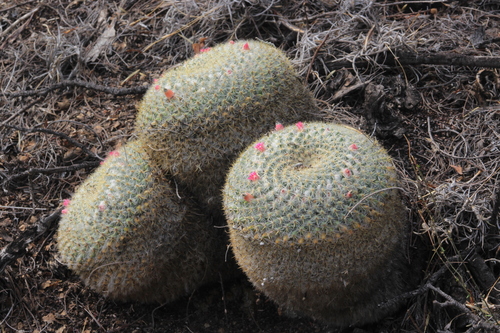
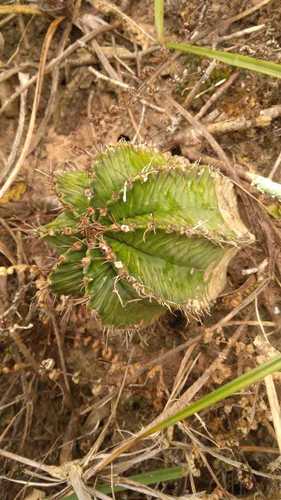
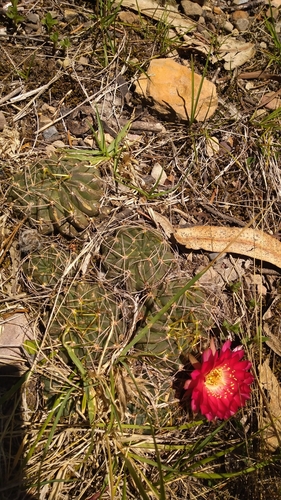
Lobivia backebergii (Werderm.) Blatt. produces spherical to short cylindrical light green shoots that grow 4–5 cm tall and 4–5 cm wide. Its stems can grow singly or in clusters, are 4–5 cm thick, and have around 15 notched, spirally arranged ribs covered in grey-brown spines. Areoles on the ribs are initially woolly and hairy, spaced 1 to 1.5 centimeters apart. One to eleven thorns emerge from each areole, and cannot always be distinguished as central or peripheral thorns. Thorns start brown, turn gray with age, are slender, curved, almost hooked at the tip, and measure 0.5 to 5 centimeters long. Large, showy flowers bloom in summer; they range from light to carmine-red, often have a bluish sheen and a white throat, appear on the side of the shoot near the top, and open during the day. The flowers grow up to 5.5 centimeters long and 4 centimeters in diameter, with a slender flower tube. The small, spherical fruits are semi-dry and split vertically. This species requires a minimum temperature of 10 °C (50 °F), so it must be grown under heated glass in temperate regions. It is widespread in the Bolivian departments of La Paz and Cochabamba, and the Peruvian regions of Ayacucho, Cusco and Huancavelica, where it grows in puna vegetation at altitudes between 3200 and 3900 meters. The subspecies Echinopsis backebergii subsp. wrightiana has received the Royal Horticultural Society's Award of Garden Merit.