About Lobelia telekii Schweinf.
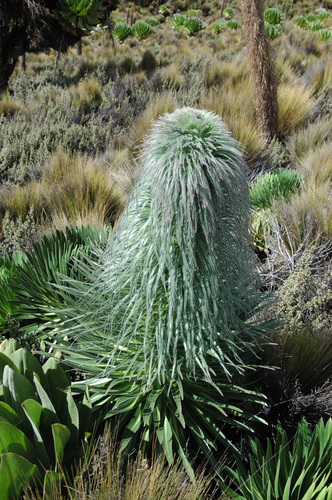
Lobelia telekii Schweinf. is a species of flowering plant in the Campanulaceae family, endemic to the alpine zones of Mount Kenya, Mount Elgon, and the Aberdare Mountains of East Africa. It grows at higher altitudes on well-drained sloped hillsides; on Mount Kenya, it occurs between 3,500 and 5,000 metres (11,500–16,400 ft) in elevation, where it inhabits drier hill slopes, while its close relative Lobelia keniensis prefers moister valley bottoms. Partially fertile hybrids between the two species do occur. It is a semelparous species, meaning it grows vegetatively for around 40 years, puts all its reproductive effort into producing a single large inflorescence up to 3 metres (10 ft) tall, then dies. Most individuals form a single rosette, though a very small number grow multiple rosettes connected by an underground stem. The species takes its common nickname, "Cousin Itt lobelia", from its overall appearance created by large, long, hairy bracts that subtend each individual flower. The bird-pollinated flowers are hidden among these large bracts within the inflorescence. Leaves and bracts are blue-green, and flowers are purple. Each flower can produce up to several hundred small dark seeds, less than 1mm in diameter, which are passively dispersed. L. telekii inflorescences have a large pith volume that acts as an internal water storage reservoir, and the plant secretes a polysaccharide into this reservoir. The species also retains marcescent foliage, which may provide insulation. These adaptations help it survive the cold alpine climate; it has also been found that polysaccharides held in the central rosette of leaves and in the inflorescence are thought to trigger ice nucleation, which prevents the plant's own tissue from freezing. Lobelia telekii is named for Austro-Hungarian explorer Count Sámuel Teleki. The bitter toxic sap of Lobelia telekii contains alkaloids, likely including lobeline, which generally deters herbivores. On Mount Kenya, the rocky moraine hill slopes where it grows are home to Mount Kenya rock hyrax, which sometimes eat the plant's leaves and inflorescences, especially in the dry season. Few other animals eat the plant, which is additionally protected by latex. The main pollinators of Lobelia telekii are birds, most notably the scarlet-tufted malachite sunbird (Nectarinia johnstoni), which visits the inflorescence to feed on nectar. Lobelia telekii is protandrous: male flowers, which produce more sugar than female flowers, develop first at the apex of the inflorescence, while female flowers appear later at the base of the inflorescence, and sunbirds tend to visit the male flowers first. Scarlet-tufted malachite sunbirds defend their preferred stands of Lobelia telekii from other members of their species. The ice-resistant adaptations of Lobelia telekii have inspired the design of ice protection mechanisms for solar panels and other structures.