About Lobelia laxiflora Kunth
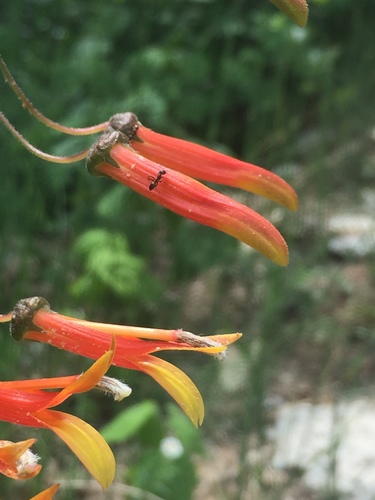
Lobelia laxiflora Kunth is a species of flowering plant in the bellflower family Campanulaceae. It is native to the Americas, distributed across South America, Central America, and North America, reaching as far north as Arizona in the United States. It has multiple English common names: Mexican lobelia, Sierra Madre lobelia, Mexican cardinalflower, looseflowers lobelia, and drooping lobelia. In Spanish and Nahuatl, it is called aretitos, acaxóchitl, and chilpanxóchitl. This species has received the Royal Horticultural Society's Award of Garden Merit for use as an ornamental plant. Generally, it is a perennial herb, subshrub, or shrub. It usually grows to a maximum height of around 1.5 meters, though it has been recorded reaching 3 meters. Its leaves vary in shape, size, and texture. Its inflorescence is a raceme up to 40 centimeters long, which holds leaflike bracts and multiple flowers. Individual flowers can measure over 6 centimeters long, including their tubular base and corolla with narrow, spreading lobes. Flowers are most commonly red, and sometimes yellowish. The anthers extend out from the corolla. This plant produces seeds, and also spreads through underground runners. In Mexico, it grows in pine-oak forest habitat. In Arizona, it has been observed growing in riparian woodland. The hummingbird flower mite Tropicoseius chiriquensis lives in the flowers of this plant, feeding on its nectar and pollen and laying eggs there. Each Lobelia laxiflora flower blooms for approximately one week, which is enough time for the mite to complete its full life cycle. Like other lobelia species, Lobelia laxiflora contains alkaloids that are useful for medicinal purposes. Several new chemical compounds have been identified through chemical analysis of this plant.