About Lobelia anceps L.f.
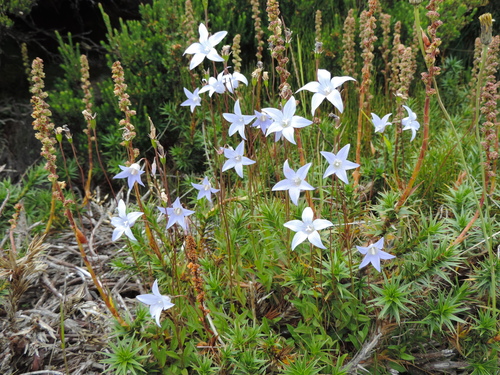
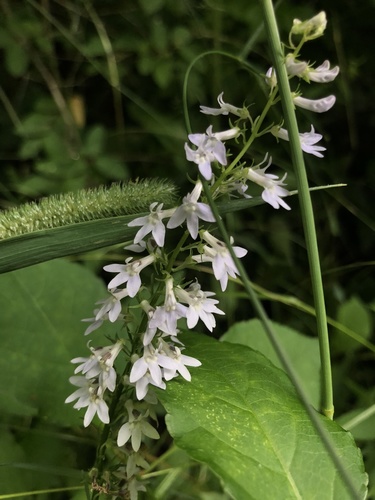
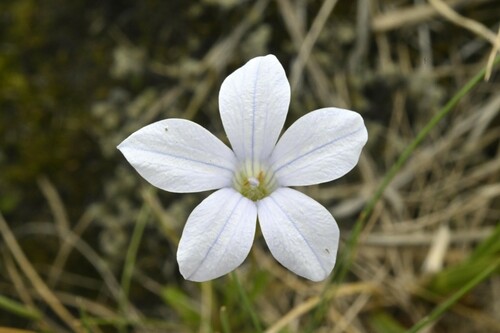
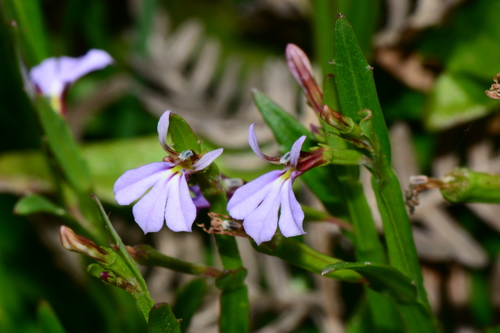
Lobelia anceps L.f. is a glabrous perennial herb that grows prostrate to ascending, reaching a typical height of 50 cm (20 in). Branches occasionally grow roots at their nodes. Its leaves are variable in shape, ranging from linear-elliptic, oblong to oval spoon-shaped, are angled or more or less winged, and measure 10–85 mm (0.39–3.35 in) long and 1.5–20 mm (0.059–0.787 in) wide. Leaf margins can be toothed or smooth, and the leaf base and petiole are often red to purplish; petioles are 0–20 mm (0.00–0.79 in) long. Flowers are blue, purple, or occasionally white, and are borne singly in leaf axils on a pedicel 2–12 mm (0.079–0.472 in) long. The corolla is usually 5–15 mm (0.20–0.59 in) long, with its two upper petals narrower than the three lower petals. Flowering occurs mostly in summer and autumn. The fruit is a conical capsule, 5–15 mm (0.20–0.59 in) long and 1.5–3 mm (0.059–0.118 in) in diameter, which may be smooth or covered in soft, upright hairs. This species, commonly called angled lobelia, occurs in coastal areas of New South Wales, Victoria, Queensland, and South Australia, where it grows along the banks of pools, creeks, and rivers. In Western Australia, it grows between the Mid West and Goldfields-Esperance regions, in sandy-peat-clay soils over granite or limestone.