About Lobaria pulmonaria (L.) Hoffm.
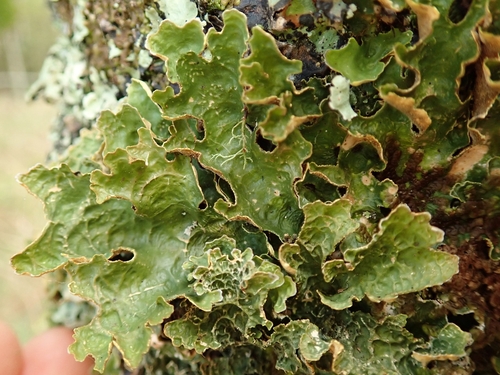
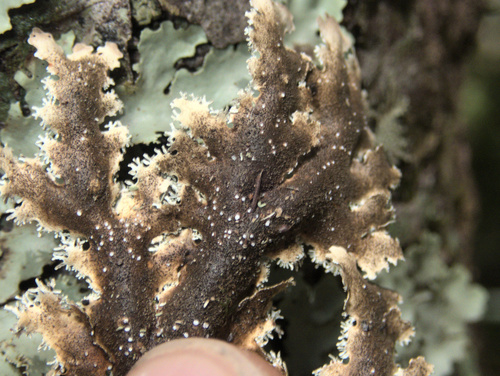
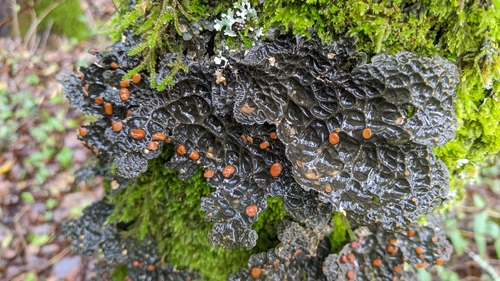
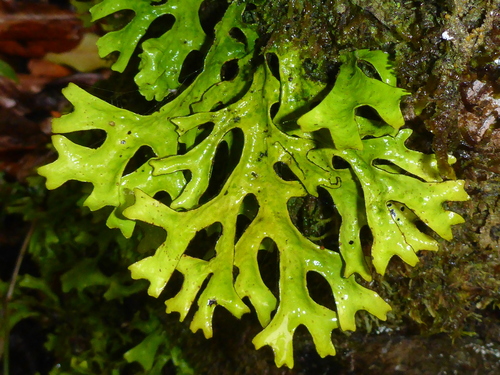
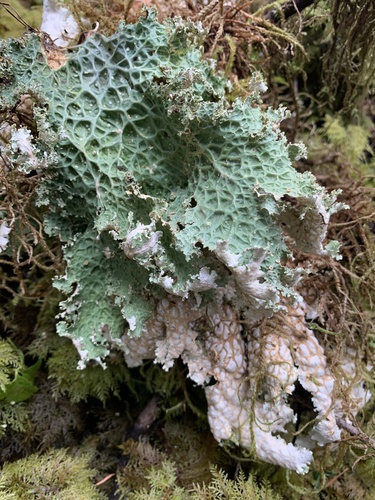
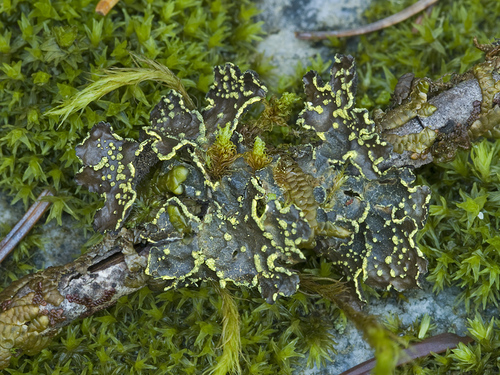
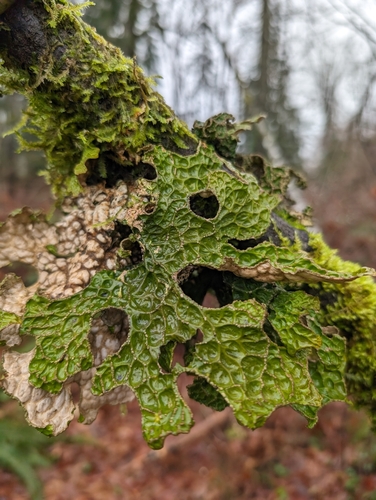
Lobaria pulmonaria (L.) Hoffm. is a foliose lichen with a leaf-like green thallus that is leathery and lobed, with a pattern of ridges and depressions on its upper surface. When moist, its thallus is bright green, and it becomes brownish and papery when dry. The lower surface of this species often has a fine layer of hairs called a tomentum. The cortex, the outer protective layer on the thallus surface, is roughly comparable to the epidermis of a green plant. The thallus is typically 5–15 centimetres (2.0–5.9 in) in diameter, with individual lobes 1–3 centimetres (0.39–1.18 in) wide and up to 7 cm long. Asexual reproductive structures called soredia and isidia are present on the thallus surface. Minute cephalodia, which are pockets of cyanobacteria 0.5–1.5 mm in diameter, are often found on the lower thallus surface; these spots are conspicuously darker than the green upper thallus surface. Like other foliose lichens, the thallus is only loosely attached to the surface it grows on. This species has a wide distribution across Europe, Asia, North America and Africa, and prefers damp habitats with high rainfall, especially coastal areas. It is the most widely distributed and most common Lobaria species in North America. In Wales, the Dolmelynllyn estate is known for its variety of rare bryophytes and lichens, including the genus Lobaria and specifically Lobaria pulmonaria. It is associated with old-growth forests, and its presence and abundance can be used as an indicator of forest age, at least in the Interior Cedar-Hemlock biogeoclimatic zone in eastern British Columbia. It also grows in pasture-woodlands. It usually grows on the bark of broad-leaved trees such as oak, beech and maple, but can also grow on rocks. In laboratory settings, L. pulmonaria has been grown on nylon microfilaments. Multiple environmental factors are thought to affect the distribution of L. pulmonaria: temperature, moisture (including average humidity, and the rapidity and frequency of wet-dry cycles), sunlight exposure, and air pollution levels. Attempting to quantitatively evaluate how much each of these factors contributes to lichen growth is difficult, because differences in the original environment where lichen thalli were collected greatly affect their heat and desiccation tolerances. Due to population declines, L. pulmonaria is considered rare or threatened in many parts of the world, especially in lowland areas of Europe. This decline has been linked to industrial forestry and air pollution, particularly acid rain. Like other lichens that contain a blue-green algal component, L. pulmonaria is especially susceptible to the effects of acid rain, because the resulting pH decrease reduces nitrogen fixation by inhibiting the algal nitrogenase enzyme. Lobaria pulmonaria becomes able to produce both vegetative and sexual propagules when it reaches approximately 25 years of age. During sexual reproduction, the species produces small reddish-brown discs called apothecia that contain asci, which forcibly release spores into the air as ballistospores. Studies of ascospore germination suggest that L. pulmonaria spores have a germination-inhibiting mechanism; germination inhibition is lifted when spores are grown in synthetic growth medium containing an adsorbent such as bovine serum albumin or α-cyclodextrin. Dispersal via vegetative propagules (through soredia or isidia) is the predominant mode of reproduction for L. pulmonaria. In this method, the protruding propagules become dry and brittle during the lichen’s regular wet/dry cycles, and can easily crumble away from the parent thallus. These fragments can develop into new thalli, either in the same location or in a new site after dispersal by wind or rain. Several steps are required for vegetative propagules to develop: degeneration of the thallus cortex, replication of green algal cells, and entanglement of fungal hyphae with the green algal cells. These steps cause an increase in internal pressure that eventually breaks through the cortex. Continued growth pushes these granules upward and out of the thallus surface. Because its shape resembles lung tissue, L. pulmonaria has been thought to be a remedy for lung diseases, following the doctrine of signatures. Its common English names are derived from this association. John Gerard’s 1597 book The Herball or General Historie of plants lists L. pulmonaria as medicinally valuable. It is still used to treat asthma, urinary incontinence and lack of appetite. In India, it is used as a traditional medicine to treat hemorrhages and eczema, and the Hesquiaht people of British Columbia, Canada use it as a remedy for coughing up blood. An ethnophytotherapeutic survey of the high Molise region in central-southern Italy found that L. pulmonaria is used as an antiseptic, and is rubbed onto wounds. Hot-water extracts of this species have been shown to have anti-inflammatory and ulcer-preventing activities. Methanol extracts have been found to have a protective effect on the gastrointestinal system of rats, possibly by reducing oxidative stress and reducing the inflammatory effects of neutrophils. Methanol extracts also have potent antioxidative activity and reducing power, likely due to the presence of phenolic compounds. Lobaria pulmonaria has also been used to produce an orange dye for wool, to tan leather, in perfume manufacturing, and as an ingredient in brewing.