About Lobaria oregana (Tuck.) Müll.Arg.
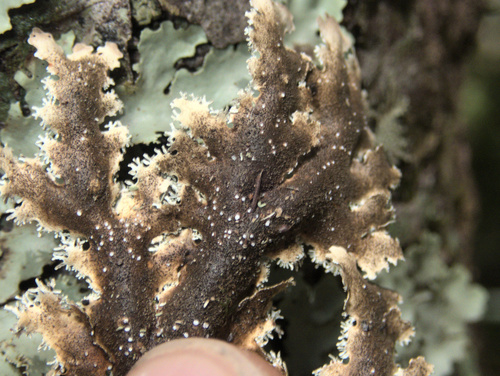
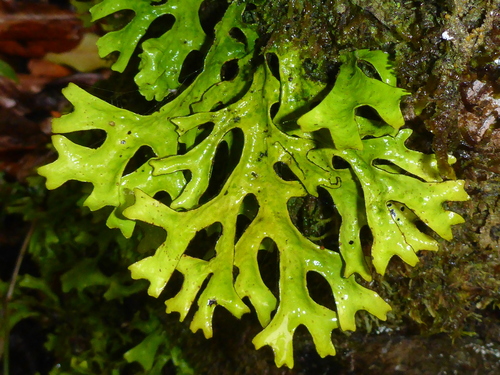
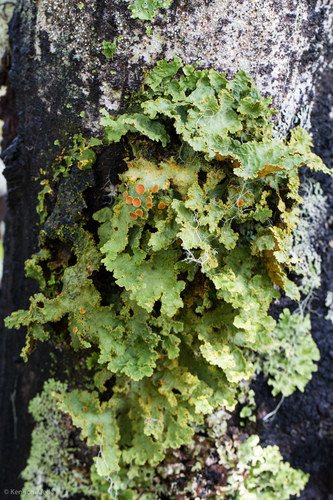
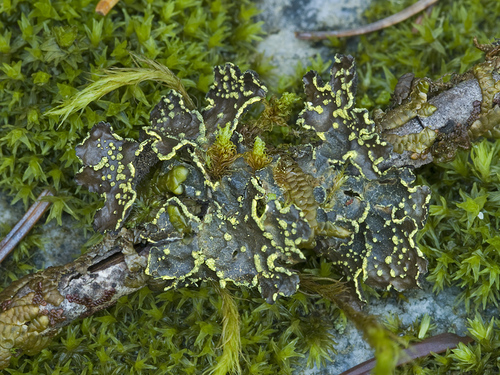
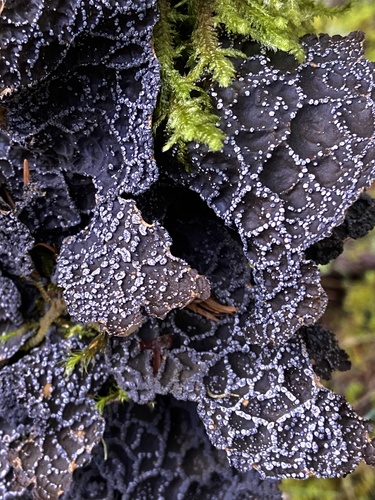
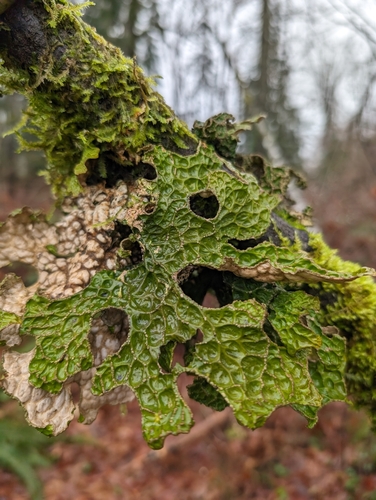
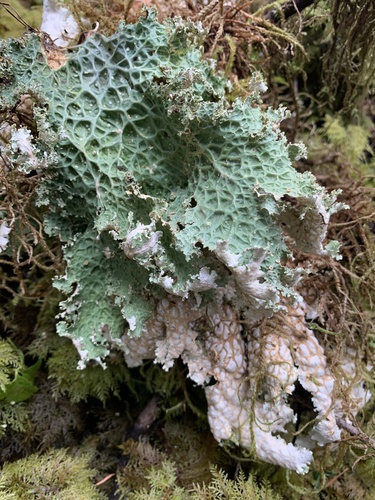
Lobaria oregana (Tuck.) Müll.Arg. is a large, loosely attached foliose lichen with broad lobes that range from 20mm to 35mm wide. Its upper surface is yellowish-green, while its lower surface is pale brown covered in fine hairs, with scattered, pale yellow hair-free patches. This lichen has strong, deeply indented ridges, no soredia or isidia, and frilly lobe margins, with small frills at the lobe tips. This lichen grows epiphytically, preferring large coniferous trees, especially Douglas firs, in old-growth forests. In Douglas fir canopies, it makes up approximately 5% of total foliage weight. It favors cool, year-round humid climates, and is sensitive to temperatures around 15 degrees Celsius. Its range runs along the cool Pacific coastline of the western United States, west of the Cascade Mountain Range, extending from southern Oregon and northern California north to Alaska, reaching into the Kenai Peninsula. Due to its requirement for cool wet conditions, it does not extend far into the Alaskan or Canadian interior. While it occurs from the Cascade and Alaskan mountains west to the Pacific Ocean, it is most common in the Coastal Range. It rarely occurs far from the cool, humid western coastline; the farthest east confirmed sighting was near Usk, Washington in 2012, the farthest south was near Westpett, California in 2015, and the farthest north was south of Indian, Alaska across Turnagain Arm in 2017. Lobaria oregana grows about 30% larger each year. It dominates the epiphyte community in its preferred habitat, reaching a total biomass of 10–15 kg per mature tree—more than the combined biomass of all other epiphyte species on the tree. It prefers growing on tree twigs and branches rather than tree trunks; on average, it has a dry weight of 3.1 kg per tree on branches, and 7.1 kg per tree on twigs. For an area with an assumed average of 12.5 kg of lichen biomass per tree and 40 mature trees per hectare, this works out to roughly 500 kg of dry lichen weight per hectare. Lobaria oregana can absorb 2.7 grams of water per gram of dry thallus, so a dry population of 500 kg per hectare reaches a total wet weight of up to two metric tons per hectare. It appears to be declining rapidly across many parts of its native range.