About Liuixalus romeri (Smith, 1953)
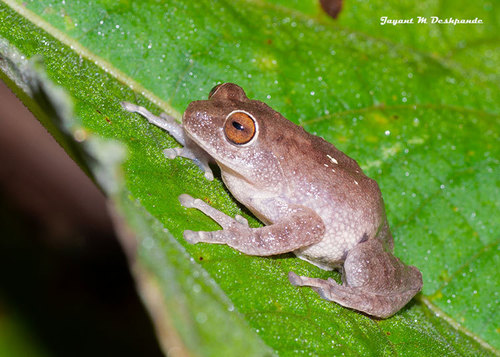
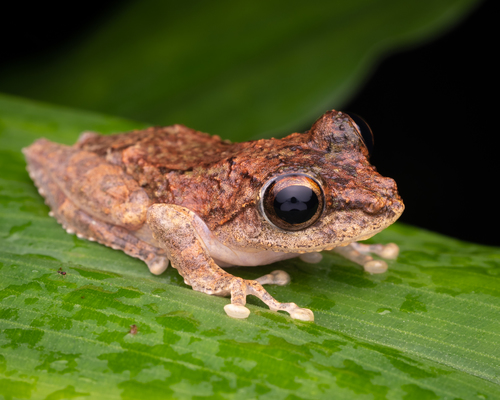
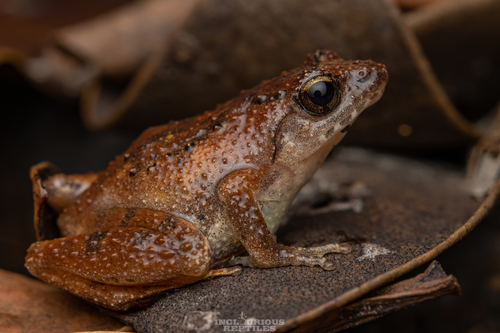
Liuixalus romeri, commonly known as Romer's tree frog, displays distinct sexual size dimorphism: females are slightly larger than males. Its dorsal body is tan brown, while its underside is white. An X-shaped marking formed by two curved black lines appears on its back; in some individuals, these lines do not meet at the midline, resulting in a chevron-shaped marking on the posterior portion of the dorsum. An additional inverted V-shaped marking is located below the X-shaped marking. Its skin is covered in fine granules, and a distinct fold stretches from the eye to the foreleg. This species has a triangular but blunt snout, with brown spots on its lips. A dark crossbar between the eyes extends out to the eyelids. Its hind legs are long and slender, marked with irregular brown-to-black cross-bands. All digits have small toe pads that let the frog cling to tree branches and leaves. Romer's tree frog inhabits well-wooded areas near small streams or other water bodies suitable for breeding. It is typically found sitting on low bushes, buried in fallen leaf litter, or resting on bare ground. For a long time, this species was only recorded on four outlying islands of Hong Kong: Lantau Island, Lamma Island, Po Toi Island, and Chek Lap Kok. In 2007, a population was also reported from Guangxi, China, far from the known Hong Kong populations. The eggs and tadpoles of this frog are vulnerable to predation by introduced mosquitofish, so the species can only breed in sites that have not yet been colonized by this fish. Breeding takes place in shallow water from early March to September. Males produce a shrill, staccato mating call. Females glue clutches of up to 120 eggs to submerged plant debris, stones, or vegetation. Brown-colored tadpoles take 4 to 6 weeks to complete metamorphosis when raised in captivity. Adult Romer's tree frogs feed on termites, small insects such as crickets, and arachnids such as spiders. This is a strictly nocturnal species. It lives approximately three years in the wild, and females are reproductively active for only two breeding seasons over their lifetime.