About Littorina littorea (Linnaeus, 1758)
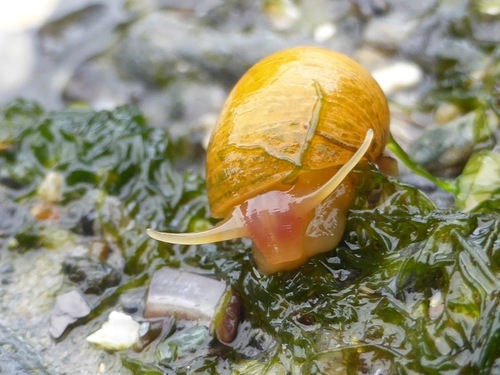
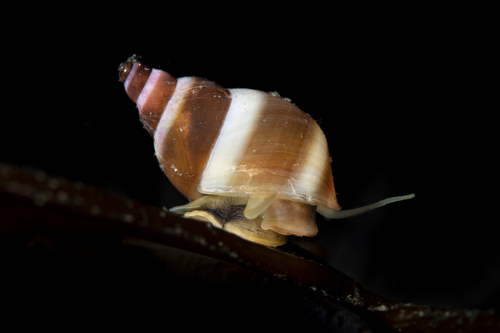
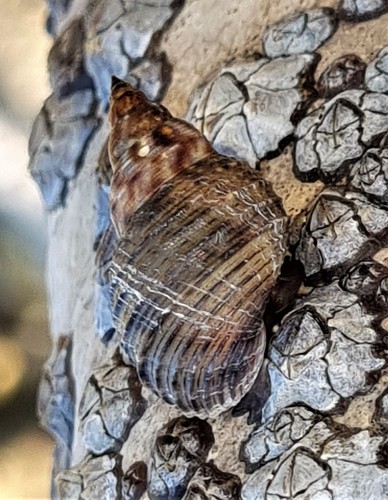
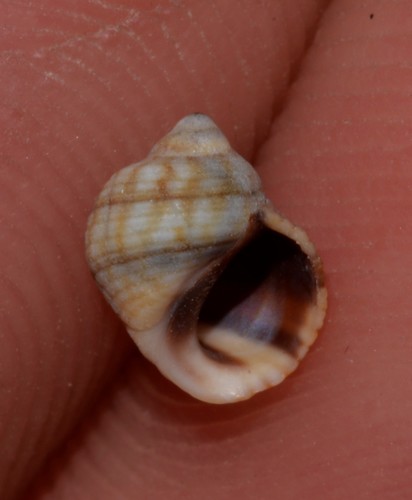
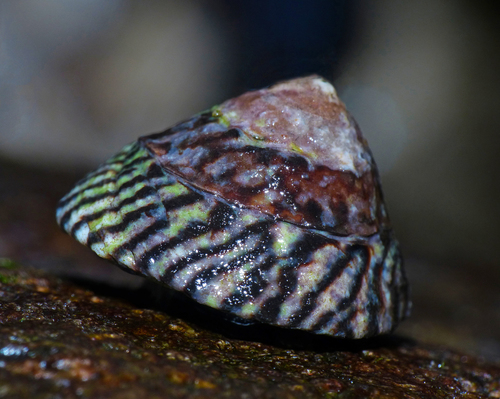
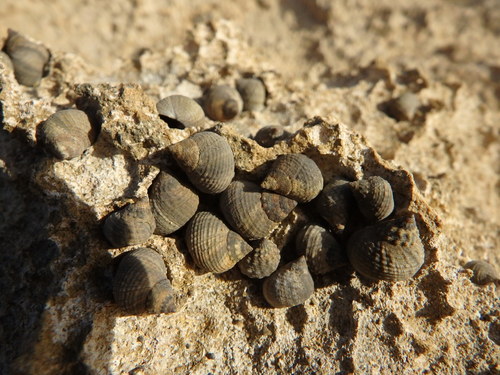
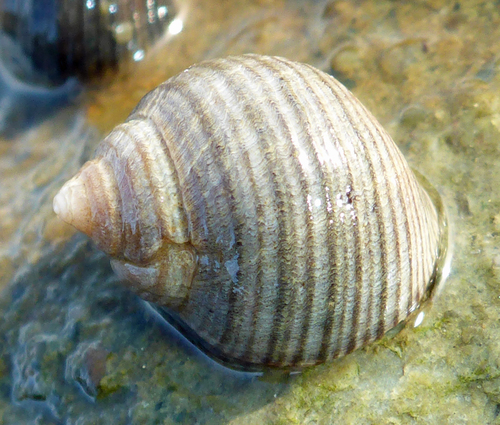
This species, commonly known as the common periwinkle, has a thick, broadly ovate shell that is sharply pointed unless eroded. The shell has six to seven whorls marked with fine threads and wrinkles, and its color ranges from grayish to gray-brown, often with dark spiral bands. The base of the columella is white, the shell has no umbilicus, the white outer lip is sometimes checkered with brown patches, and the inside of the shell is chocolate brown. At maturity, the shell width ranges from 10 to 12 millimeters (3⁄8 to 1⁄2 in), with an average length of 16 to 38 mm (5⁄8 to 1+1⁄2 in). Maximum shell height reaches 30 to 52 mm (1+1⁄8 to 2 in). Length is measured from the end of the aperture to the apex, while height is measured by placing the shell with the aperture flat on a surface and measuring vertically. Littorina littorea shows high phenotypic variation, with multiple known morphs. This variation may indicate ongoing speciation rather than phenotypic plasticity, which is relevant to evolutionary biology as it offers a chance to observe a transitional phase in organismal evolution. Common periwinkles are native to the northeastern Atlantic Ocean coasts, including northern Spain, France, Great Britain, Ireland, Scandinavia, and Russia. Over 14,000 observations for this species are available as a public dataset via the Global Biodiversity Information Facility, and additional distribution data is hosted on the Ocean Biographic Information System. The NBN Gateway hosts a distribution map of the species covering the UK and Ireland, and these different datasets may overlap. The common periwinkle lives mainly on rocky shores in the higher and middle intertidal zone, and it sometimes occupies small tide pools. It can also be found in muddy habitats such as estuaries, and it occurs at depths up to 55 metres (180 feet). When exposed to extreme cold or heat while climbing, a common periwinkle withdraws into its shell and begins rolling, which may cause it to fall into the water. Littorina littorea is oviparous, reproducing annually with internal fertilization of egg capsules that are then released directly into the sea. This results in a planktotrophic larval development period of four to seven weeks. Females lay 10,000 to 100,000 eggs contained within a corneous capsule; pelagic larvae escape from the capsule and eventually settle on the seabed. Breeding can occur year round depending on local climate. Different sources report different timelines for maturity: Benson states the species reaches maturity at 10 mm and normally lives five to ten years, while Moore suggests maturity is reached in 18 months. Some individual specimens have lived 20 years. Female specimens are typically ripe from February through the end of May, when most individuals spawn. Male specimens are mainly ripe from January through the end of May, and lose weight after copulation. Young periwinkles primarily settle between the end of May and the end of June, though other sources note earlier settlement can occur. This species appears in prehistoric shellfish middens across Europe, and researchers believe it has been an important food source in Scotland since at least 7500 B.C.E. It is still collected in large quantities in Scotland, mostly for export to Continental Europe and also for local consumption. Official Scottish landing figures show over 2,000 tonnes of winkles (the common local name for this species) are exported annually. This places winkles as the sixth most important shellfish harvested in Scotland by tonnage, and seventh most important by total value. Since actual harvests are likely twice the reported tonnage, the species may actually rank fourth by tonnage and sixth by value. Periwinkles are usually hand-picked from rocks or caught with a boat drag. They are mostly eaten in coastal areas of Scotland, England, Wales and Ireland, where they are commonly called winkles, or buckies, willicks, or wilks in some local areas. In Belgium they are called kreukels or caracoles; in Newfoundland and Labrador they are commonly called "wrinkles". They are often sold in paper bags near beaches in Ireland and Scotland, boiled in local seawater, with a pin included in the bag to help extract the soft flesh from the shell. Periwinkles are considered a delicacy in African and Asian cuisines. Their meat is high in protein and omega-3 fatty acids, and low in fat. According to the USDA National Nutrient Database for Standard Reference, raw snails in general are about 80% water, 15% protein, and 1.4% fat. Periwinkles are also used as bait for catching small fish; the shell is usually crushed to extract the soft flesh, which is then placed on a fishing hook. Following their history as an ancient food source in Atlantic Europe, they are harvested and consumed in the Azores Islands by Portuguese people, where they are usually called búzios, the general term for sea snails.