About Littoraria pintado (W.Wood, 1828)
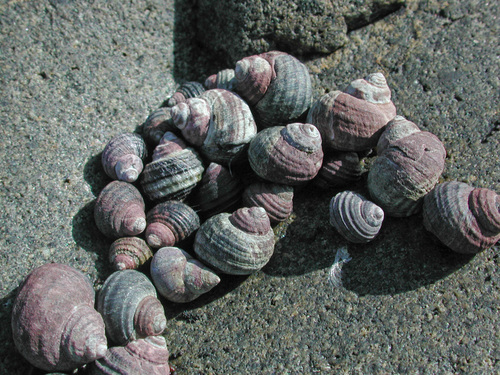
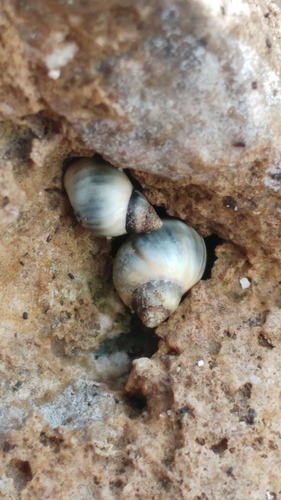
Pūpū kōlea, the common Hawaiian name for Littoraria pintado, are found on all rocky shorelines in Hawaii. They inhabit areas where waves will occasionally wet them, and can survive for long periods without constant wave spray. This species is used as a food source, but it is not commonly eaten. It can be found along rocky shores year-round, but it occurs in much greater numbers and spreads across rock flats during the winter season. In winter, high surf increases wave spray, which wets the shoreline farther inland than it does in summer. Winter is also the season when kōlea, or golden plovers, migrate to Hawaii. Pūpū kōlea can appear in such large numbers on rocky flats that they resemble kūkae, the Hawaiian word for excrement. The species' common name may derive from the fact that large groups of these snails appear at the same time of year that migrating kōlea arrive, documenting this shared natural occurrence.
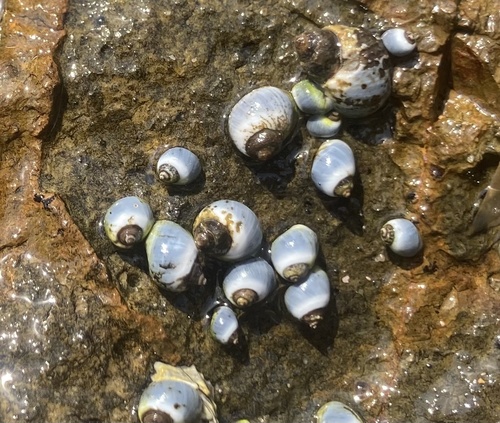
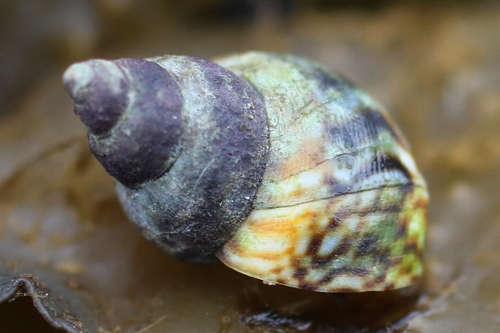
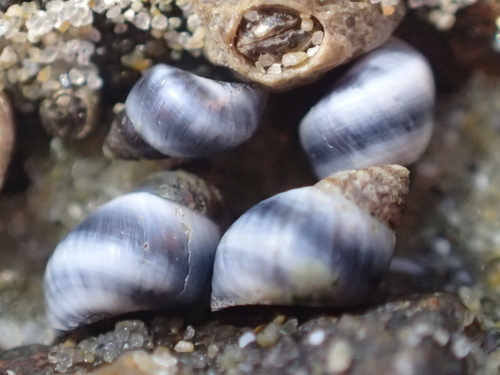
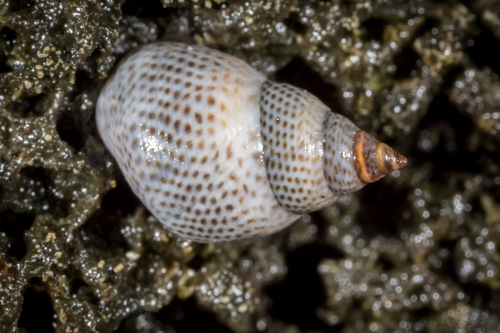
Littoraria pintado is a species of snail in the periwinkle family. Individuals of this species can grow to 10 millimeters in length, with a commonly cited adult measurement of 9 mm in length and 5 mm in diameter. The species has sexual reproduction. Its shell is conic-turbinate, marked with microscopic spiral striae, and purple-gray freckled with red-brown. Its spire holds five to nine moderately convex whorls, with a moderately impressed suture. The aperture of the shell is ovate, and the outer lip ranges from thin to moderately thick. The body of the snail is purple-gray, freckled with dark brown or black; the aperture is dark brown.
Multiple common Hawaiian names for this species include akolea, kolealea, kitkae-kolea, kolea, pipipi-kolea, and pupukolea. In Maui, the names pipipi-ʻīikolea, kolea, or akolea are used for Epitonium species. Historically, these snails, called pipipi, were eaten as a food. Children would snack on them while collecting them, prying out the meat and eating it immediately. According to Kepelino, the snails were either boiled or wrapped in leaves and broiled, and a needle was required to dig the flesh out of the shell. Some people made a broth from pipipi, adding the shells to the dish for extra flavor. Pregnant women were traditionally discouraged from eating pipipi, out of a belief that doing so would cause their children to be born with small eyes, called makapipipi.
This species of littorine is abundant alongside Nodilittorina pieta in the supratidal region along all rocky shores ranging from Midway to Hawaii. L. pintado is oviparous: it sheds its eggs into the water, where the young develop as plankton. Veligers hatch from the egg capsules about four days after spawning, and have a long planktonic life stage. L. pintado spawns throughout the year, but only during high tides. A single female can produce up to 82,000 eggs per year. Fossils of L. pintado have been found in Pleistocene deposits on Oahu.