About Litoria tyleri Martin, Watson, Gartside, Littlejohn & Loftus-Hills, 1979
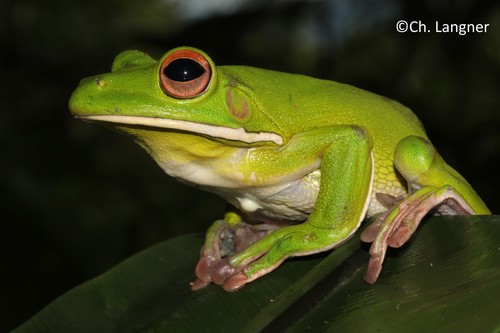
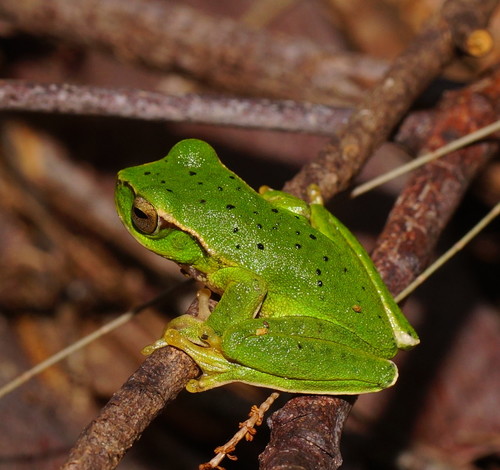
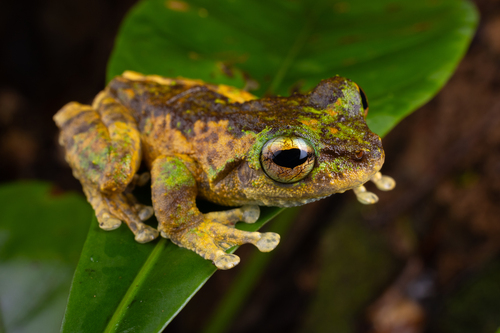
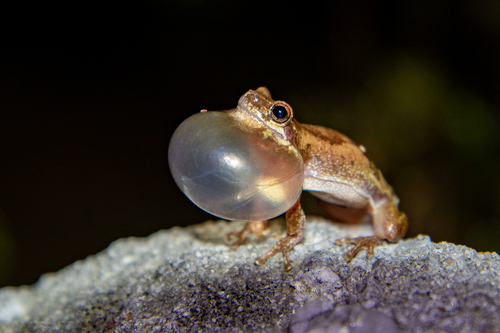
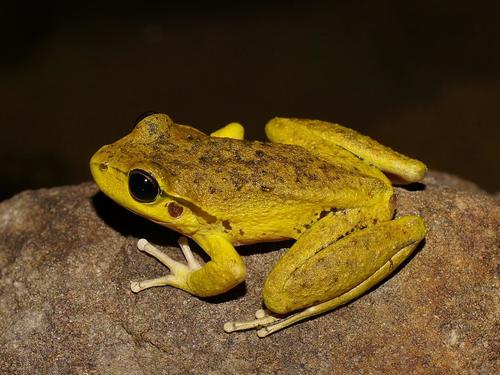
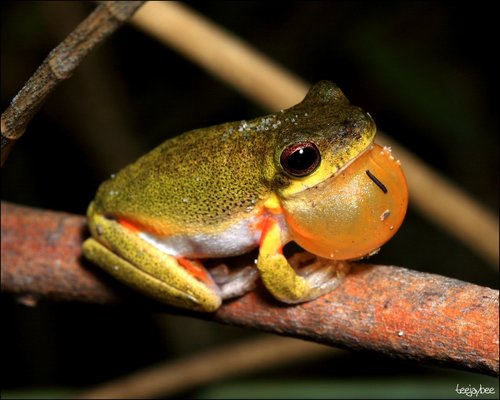
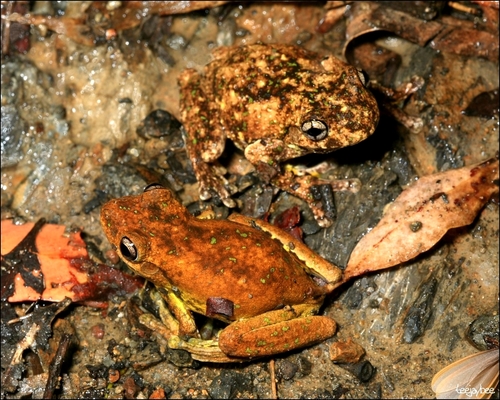
The dorsal surface of Litoria tyleri ranges from grey-brown to various shades of fawn, while its ventral surface is whitish-yellow. It has green flecks on its back, a golden iris, and cross-shaped pupils. Females grow larger than males, reaching a maximum size of around 50 mm. This species is very similar to Peron's tree frog (Litoria peronii), but they can be distinguished in several key ways. The most reliable difference is their call. L. peronii has bold black and yellow marbling on the thighs, armpits, hands, and feet, while L. tyleri only has faint yellow and brown marbling on the legs and armpits, with no marbling on the hands and feet. L. tyleri also lacks the distinct black line above the tympanum that is present in L. peronii. As an arboreal frog, L. tyleri has toe pads larger than its toes and fingers, which helps it grip branches effectively. Its hands are partially webbed, its toes are fully webbed, and the tympanum is visible. Males turn a bright strong yellow during the breeding season. This species lives in coastal forest and cleared land, and is most commonly found around permanent dams, swamps, and ponds. During spring and summer, often after rain, males call from vegetation surrounding these water bodies. The call of L. tyleri sounds like a short laughing noise, similar to the call of Peron's tree frog, but it does not have a downward inflection.