About Litoria peronii (Tschudi, 1838)
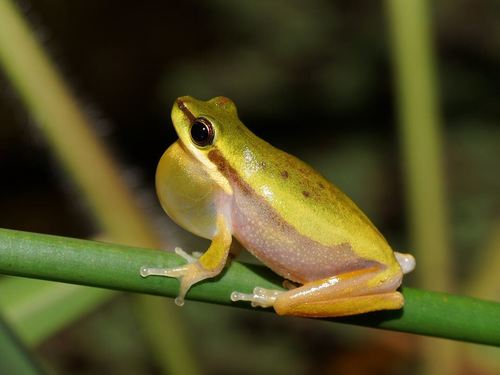
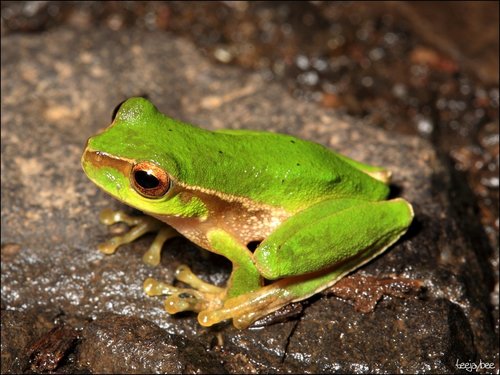
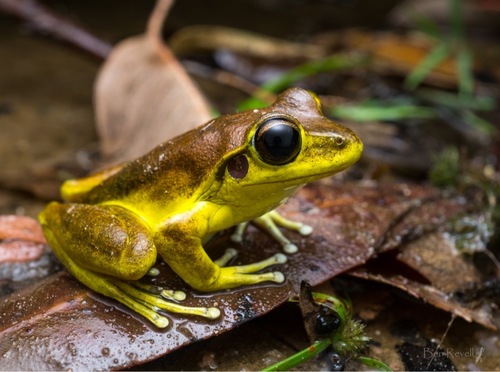
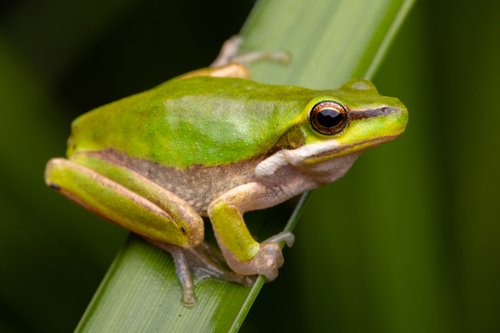
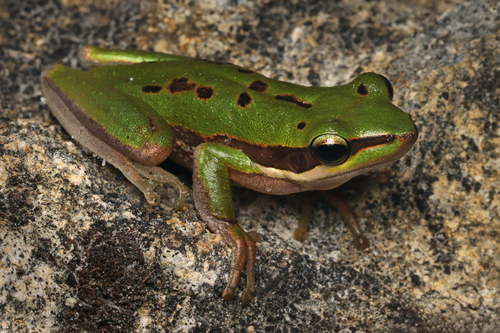
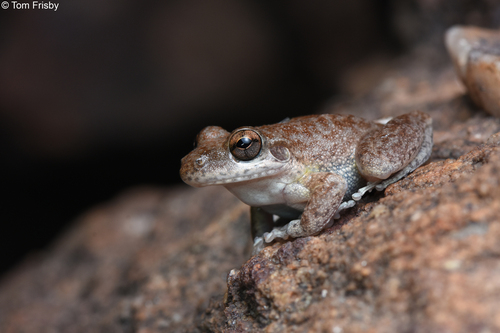
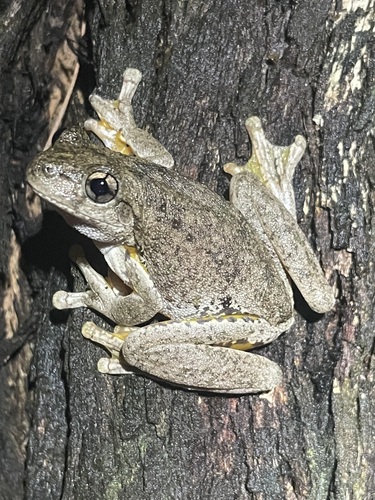
Peron's tree frog, scientifically known as Litoria peronii, is one of Australia's most variably coloured frog species, and can change its body colour in less than one hour. The species does not tolerate being handled for long periods of time. Its colouration ranges across different shades of grey and brown, with the lightest morph being nearly white. The inner thighs, armpits, and groin have mottled yellow and black patterning. Emerald spots occasionally appear on the frog's back, and the number of these spots increases as the individual ages. One unusual trait for members of the genus Litoria is its cross-shaped pupils. Within the genus Litoria, only Tyler's tree frog shares this cross-shaped pupil trait with Peron's tree frog. Adult male Peron's tree frogs measure around 44–53 mm in length, while adult females are 46–65 mm long. These frogs prefer habitats with abundant climbing structures, including stones and sticks, and can stay submerged in water for long periods of time. The call of Peron's tree frog is a high-pitched cackle, which has given the species two additional common names: the laughing tree frog and the maniacal cackle frog. This species occurs in forests, woodlands, shrublands, and open areas, and is often found far from permanent water sources. It occupies a wide range of ecological niches, and is predominantly arboreal, living in tree hollows, bark cracks, and underneath peeling bark. The frog is commonly found near human settlements, for example in suburban Sydney, and uses artificial ponds as breeding water. It is often seen on windows or near lights at night, where it hunts insects that are drawn to these artificial light sources. Along the Murray River in South Australia, it can frequently be found on houseboat windows at dusk and beneath street lamps.