About Litoria ewingii (Duméril & Bibron, 1841)
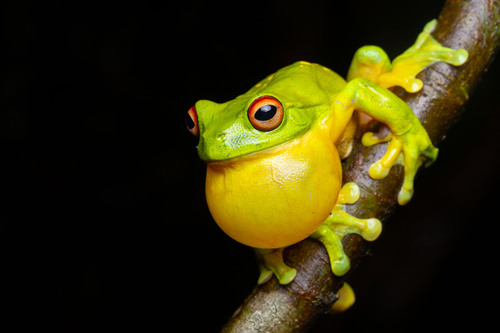
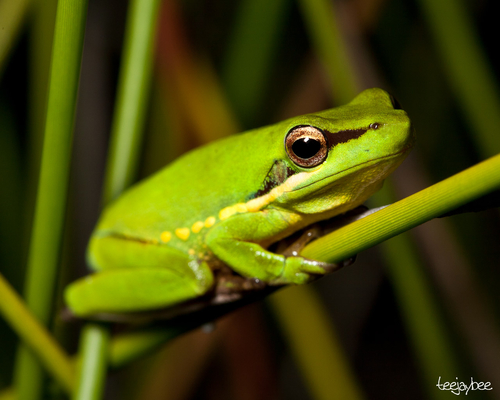
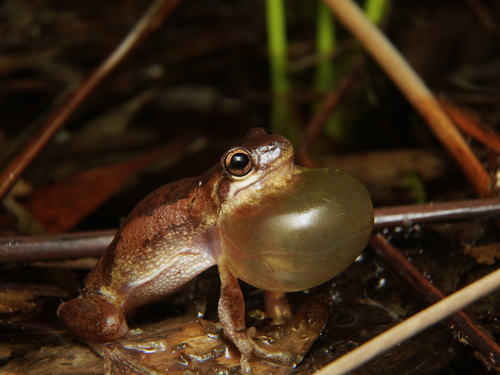
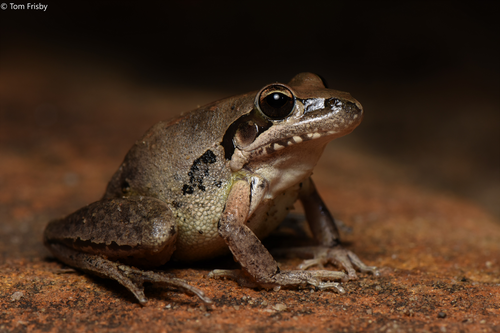
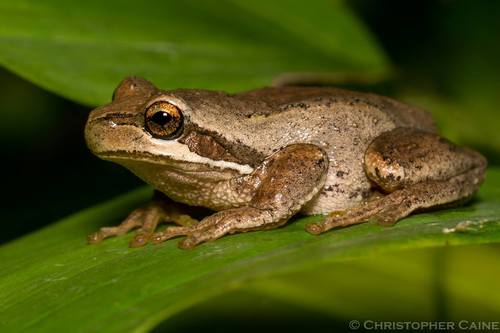
Litoria ewingii, first described by Duméril & Bibron in 1841, reaches up to 45 millimeters (1.8 inches) in total length. Its dorsal (back) surface ranges from pale to dark brown, with a broad darker patch that starts at the eyes and covers most of the back. Pure green and green-striped color morphs are also common; some individuals from western Victoria and south eastern South Australia may be partially or entirely green. A dark stripe runs from the nostril, across the eye and tympanum, all the way to the shoulder. A pale white stripe lies below this dark stripe, running from the mouth to the arm. The backs of the thighs are orange with no black marbling, the only exception being specimens from the Adelaide region. This lack of marbling distinguishes Litoria ewingii from the closely related similar species, the whistling tree frog Litoria verreauxii. The belly of this species is cream-colored. This frog is native to south-eastern Australia, where it occurs naturally in South Australia, Victoria, New South Wales, and Tasmania. It was intentionally introduced to Greymouth on New Zealand's West Coast in 1875, and has since become widely established across New Zealand's North Island, South Island, and Chatham Islands. Litoria ewingii occupies a very broad range of habitats, including forests, farmland, heathland, semi-arid areas, alpine regions, and suburban areas. It is especially common in suburban parts of Adelaide, Melbourne, and Hobart. In these suburban areas, individuals are often seen on window panes at night, drawn there by flying insect prey. Males produce a whistling weep-weep-weep call from the edges of or while floating in the water of dam impoundments, ditches, ponds, and streamside pools. Males call throughout the year, with calling activity increasing particularly after rain. The species' eggs are easy to identify, as they are wound around submerged grass stems, aquatic vegetation, and sticks. Litoria ewingii is able to survive being frozen, though freezing likely imposes significant physiological costs to the individual.