About Litoria bicolor (Gray, 1842)
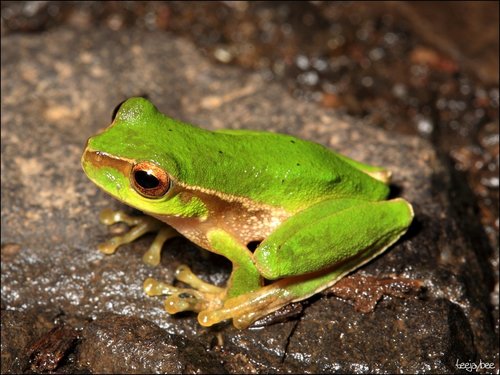
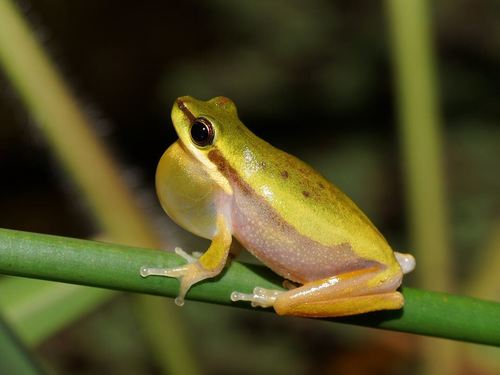
The northern dwarf tree frog, scientifically named Litoria bicolor, is a small, slender tree frog that reaches a maximum length of 30 mm. Its back (dorsal surface) is green, with a thin bronze stripe running along the side of the back from the eye, and it often has an additional central bronze stripe along the spinal region. A narrow white stripe extends from below the eye at the corner of the mouth to the base of the arm. The belly (ventral surface) is cream or yellowish, and the thighs and groin display golden reflections. Male individuals have a darker-speckled throat. The skin is granular on the belly and thigh region, and smooth across all other areas of the body. This frog has a golden iris, a clearly visible eardrum, no vomerine teeth, and a prominent pectoral fold. Disks are present on both the fingers and toes; the fingers are slightly webbed, fringed, and extend about three-quarters of the length of the palm. It has an inner metatarsal tubercle but no outer one, and its second finger is longer than its first. In terms of ecology and behaviour, this species is most abundant in grassland or marshy areas, but it can also be found along permanent or semi-permanent streams, billabongs, and floodplains. Breeding activity begins with summer rains. Females lay 10 to 24 eggs on submerged vegetation in temporary pools. Males call from elevated positions around breeding sites. Their call has the structure "wree-e-eck pippip", where the second part of the call begins before the first part ends. It takes 70 to 80 days for tadpoles to complete metamorphosis into frogs.