About Litocranius walleri (Brooke, 1879)
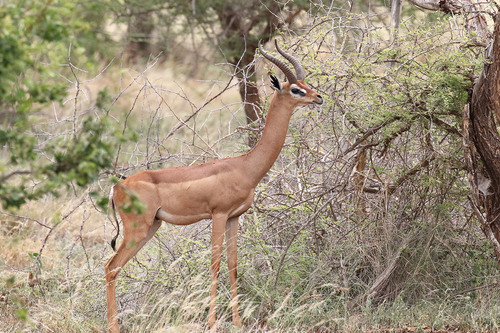
The gerenuk (Litocranius walleri) is a notably tall, slender antelope that resembles gazelles. It is defined by its long, slender neck and limbs, flat wedge-shaped head, and large round eyes. This species is sexually dimorphic. Males stand 89–105 cm (35–41+1⁄2 in) tall at the shoulder, while shorter females measure 80–100 cm (31–39 in). Head-and-body length typically ranges between 140 and 160 cm (55 and 63 in). Males weigh 31 to 52 kg (68 and 115 lb), and lighter females weigh 28–45 kg (62–99 lb). The 25–35 cm (10–14 in) long tail ends in a black tuft. The gerenuk’s smooth coat has two distinct colorations: reddish brown on the dorsal back or saddle, and lighter fawn to buff on the flanks. The underbelly and inner legs are cream-colored, and white fur surrounds the eyes and mouth. Females have a dark patch on the crown of the head. Only males have horns, which are lyre-like S-shaped, curved backward then slightly forward, and measure 25–44 cm (10–17+1⁄2 in). The gerenuk shares range (is sympatric) with the dibatag in eastern and central Somalia and southeastern Ethiopia. Both species are brachyodonts, share several facial and cranial features, have two-toned coat coloration, and have strong thick horns that only occur in males. However, key morphological differences between the two species separate the gerenuk from the dibatag, including differences in horns, horn cores, tail, the postorbital area, and basioccipital processes. The gerenuk has a longer, heavier neck and a shorter tail than the dibatag. One finer difference is that the gerenuk lacks an inward-curving lobe on the lower edge of the ear near the tip. Gerenuk subspecies are similar in coloration; the southern gerenuk is the smaller of the two recognized subspecies. Gerenuk growth occurs over a period from 4 months to 2.5 years, with consistent stage-related changes. At four months, a young gerenuk’s shoulder height is about two-thirds that of an adult female. At six months, shoulder height reaches roughly three-quarters of an adult female’s. At eight months, horn tips are clearly visible at approximately 1cm long. By one year, shoulder height is nearly equal to that of an adult female, but the body is more lightly built; horns are slightly less than half ear length and have begun to curve. At two years, horns are around 1.5 times ear length, the second curve becomes noticeable, and horn tips begin to turn forwards. By two and a half years, the double curve of the horns is nearly complete. The gerenuk is a diurnal species, active mainly during the day, though it typically stands or rests in shade during midday. Foraging and feeding is the primary daily activity, and females tend to spend more time feeding than males. The gerenuk may expose itself to rain, likely to cool its body. Its social structure centers on small herds of two to six members. Herds are typically made up of a single sex, though female herds also include juveniles. Some males live solitary lives. Fighting and long-distance travel are uncommon, which may be an energy-saving strategy to reserve energy for foraging. Both sexes maintain home ranges of 3–6 km2 (1–2+1⁄2 sq mi) that may overlap with those of other individuals. Male home ranges are scent-marked with preorbital gland secretions and guarded, so they can be classified as territories. The gerenuk’s tendency to stay sedentary increases with age. Gerenuk reproduce throughout the year. Females reach sexual maturity around one year of age, and males reach sexual maturity at 1.5 years. In the wild, however, males usually only successfully breed after acquiring a territory, which typically happens around 3.5 years. The gestation period is around seven months, and one calf is born at a time, weighing approximately 3 kg (7 lb) at birth. In 2010, the first gerenuk offspring produced via artificial insemination were born at White Oak Conservation in Yulee, Florida. Four female calves were born in this first group, and one of these four was later successfully inseminated by a collaboration between White Oak and SEZARC (South-East Zoo Alliance for Reproduction & Conservation), producing a second generation of artificially inseminated gerenuk calves. Gerenuk can live 13 years or more in captivity, and live at least eight years in the wild.