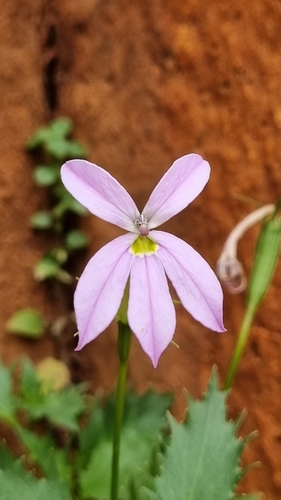
About Lithotoma petraea (F.Muell.) E.B.Knox
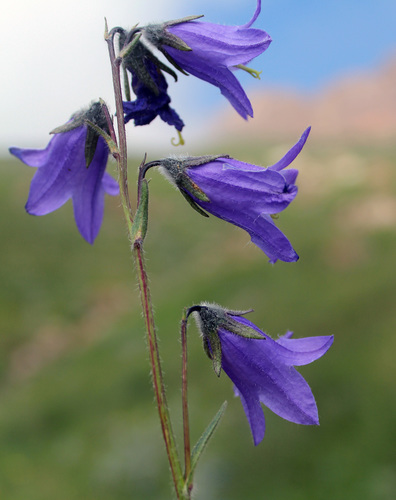
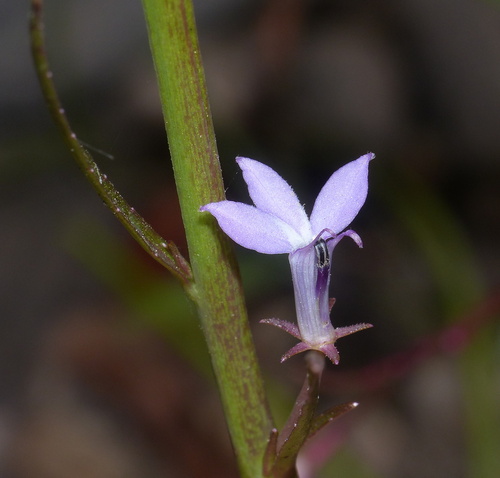
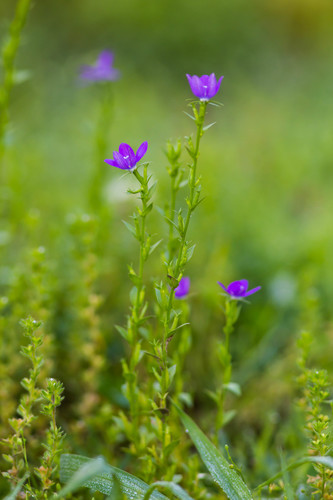
Lithotoma petraea (also referenced as Isotoma petraea) is an erect, spreading herb that can be perennial or annual. It has smooth branches, and typically grows 0.2 to 0.6 metres (0.7 to 2.0 ft) tall. Its leaves are smooth, ranging from narrowly egg-shaped to elliptic, and measure 3–7.5 cm (1.2–3.0 in) long by 1–3.5 cm (0.39–1.38 in) wide. Leaves on the lower sections of branches have petioles, while leaves near the apex of branches are sessile; leaves are sharply lobed, bear unevenly spaced teeth, and end in a sharp point. Flowers are borne singly on wiry peduncles 8–25 cm (3.1–9.8 in) long. They are generally described as blue-purplish, though the corolla is mostly white that may have a purplish-blue flush. The calyx is made up of narrow-triangular, pointed segments 5–12 mm (0.20–0.47 in) long. The floral tube is light green, 14–20 mm (0.55–0.79 in) long, with prominent veins. The smooth petals are lance-oblong, 9–12 mm (0.35–0.47 in) long, tapering sharply to a point. Fruits are rounded, slightly ribbed, and 12–22 mm (0.47–0.87 in) long. Flowering occurs mostly in summer. This plant grows on breakaways, among rocky outcrops, and in rock crevices. In Western Australia, it occurs in the Mid West, Wheatbelt, and Goldfields-Esperance regions, growing in shallow sandy soils over granite. In New South Wales, it grows west of Wilcannia, mostly on slopes and rocky sites in shallow granite-based soils. In South Australia, it is a widespread species that grows in rocky locations.