About Lithospermum incisum Lehm.
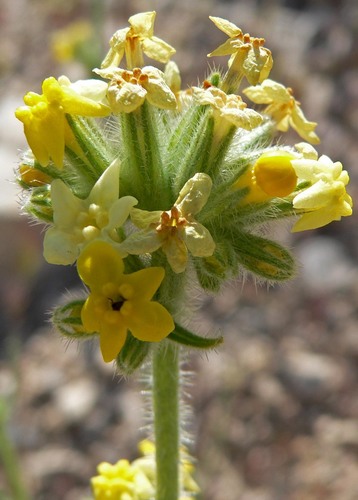
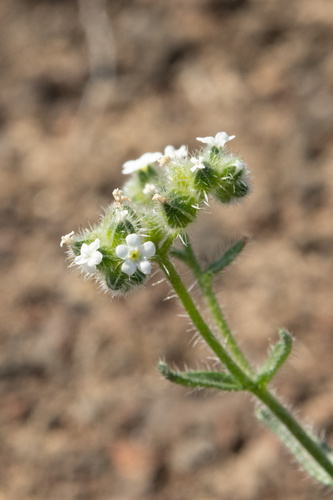
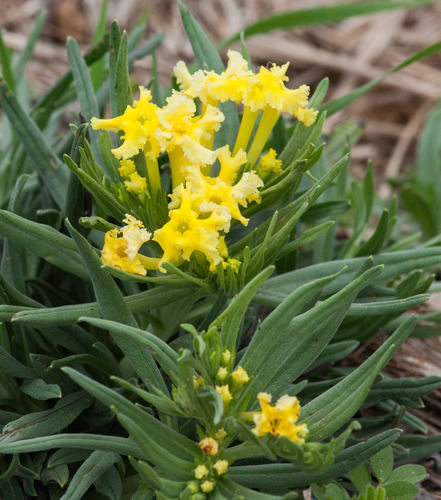
Lithospermum incisum Lehm., commonly called fringed gromwell, is a hairy perennial herb that grows from a narrow brown to black taproot and a woody caudex. It produces a cluster of stems that reach up to approximately 30 centimetres (12 inches) long. Narrow, pointed leaves up to 6.5 cm (2+1⁄2 inches) long line these stems. It blooms from May to July, producing slender, trumpet-shaped flowers that range in color from pale to bright yellow or gold. Open flowers can be close to 4 cm (1+1⁄2 inches) long, with a corolla face 1 to 2 cm wide, and their lobes are sometimes ruffled. Smaller closed cleistogamous flowers are the main source of this plant's seed. The fruit is made up of four nutlets, each about 3 millimetres (1⁄8 inch) long. This species is native to most of central and western Canada and the United States. It grows in dry open areas, foothills, and pinyon–juniper woodland. Fringed gromwell does not tolerate transplanting well when it is actively growing, and its leaves often turn black after transplanting during this period. Transplanting when the plant is dormant causes less damage, as long as most of the pencil-sized roots are kept intact. It grows best in very sandy, well-draining soils, though it can also grow successfully in soils that contain some loam or clay. Native Americans used this plant medicinally. Ground leaves, roots, and stems were rubbed onto limbs to reduce paralysis. Among the Zuni people, a salve made of powdered root is applied ceremonially to swelling anywhere on the body. A poultice of the root is used, and a decoction of the plant is consumed to treat swelling and sore throat. Powdered root is combined with bum branch resin to treat abrasions and skin infections. An infusion of the root is taken to treat stomachache and kidney problems. Leaves are bound to arrow shafts close to the point, hidden under sinew wrapping, and used in wartime.