About Lithopoma tuber (Linnaeus, 1758)
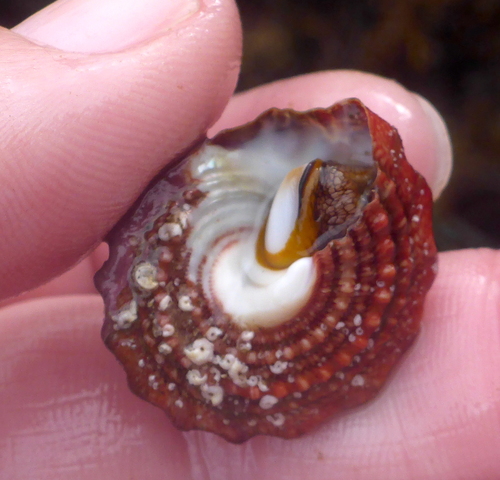
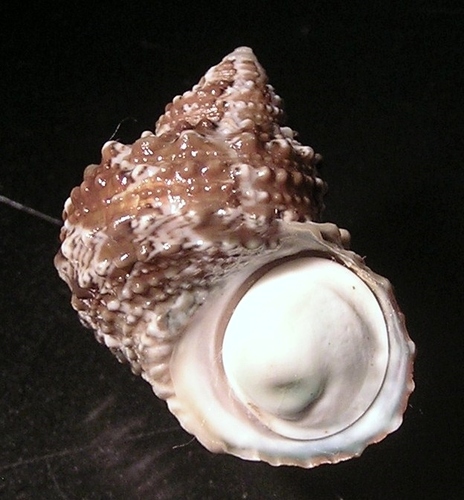
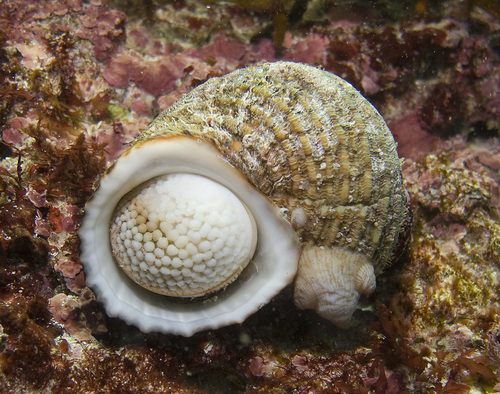
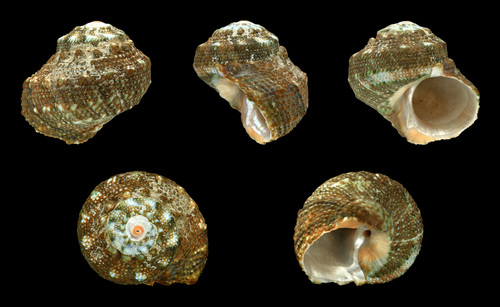
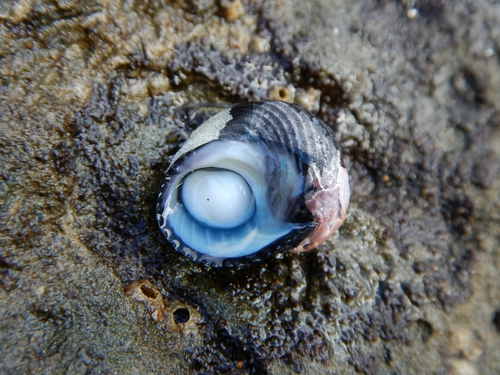
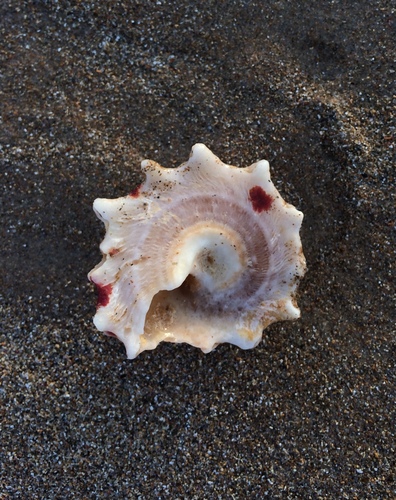
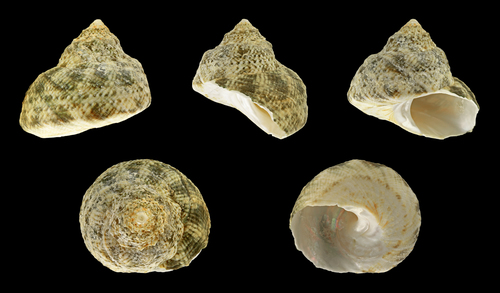
The shell of Lithopoma tuber ranges in size from 25 mm to 75 mm. It is an imperforate, very solid shell with a turbinate-conic shape. The shell has a color pattern of dirty white or pale green, with radiating brown patches on the upper surface, and irregular lighter markings on the lower surface. The shell is made up of six whorls. The uppermost two whorls are smooth due to erosion. The remaining whorls have oblique coarse folds and fine wrinkles running in the same oblique direction across their upper surfaces, and are somewhat shouldered. These whorls have an obtuse angle near the periphery; above this angle, several faint beaded spiral lirae run around the whorl, and the surface is roughened into a shagreen texture by the intersection of incremental growth striae and oblique wrinkles. The base of the shell is nearly smooth. The oval aperture is very strongly oblique, and has a silvery interior. The short columella is wide, usually has two small tubercles at its base, and is excavated in the area where an umbilicus would otherwise sit. The operculum is oval, with its nucleus positioned close to the side. The outer surface of the operculum is white or slightly brownish, very convex, nearly smooth, and has a small excavation near its center. This marine species is found off the coast of Southeast Florida, USA, and off the West Indies. It inhabits waters at depths ranging from 0 m to 30 m.