About Lithognathus mormyrus (Linnaeus, 1758)
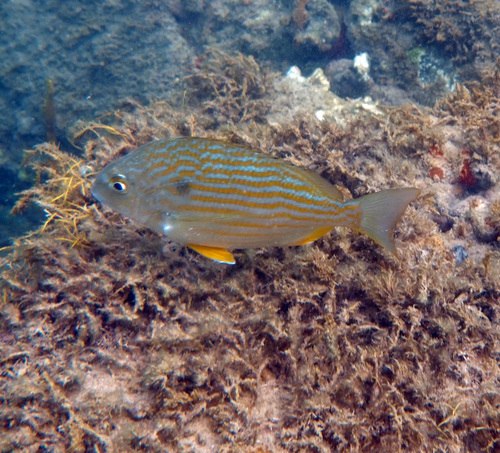
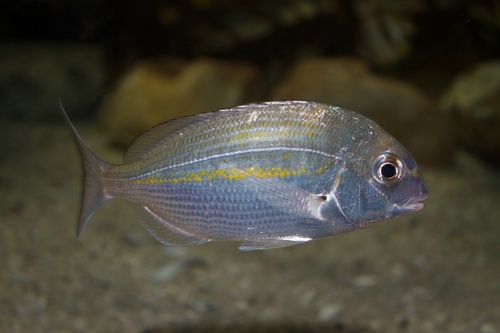
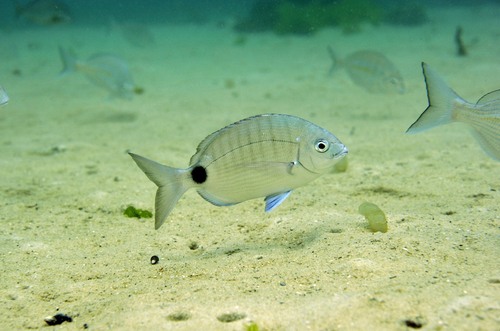
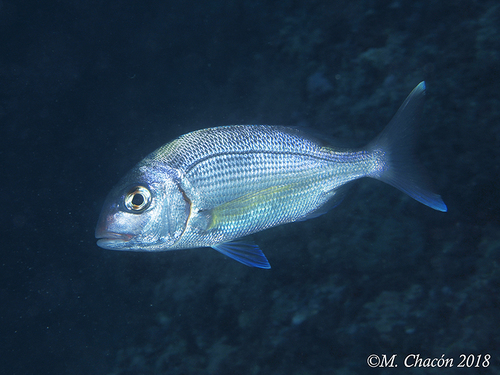
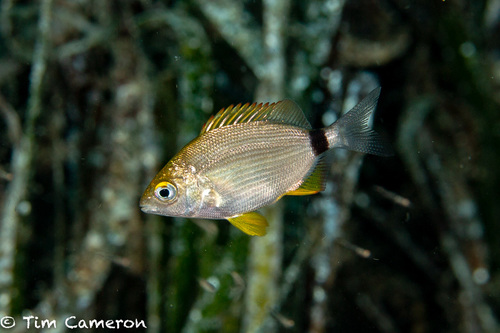
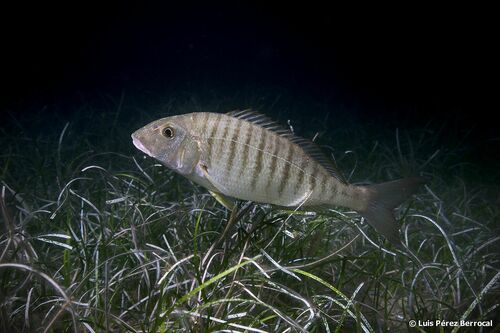
The sand steenbras, scientifically named Lithognathus mormyrus (Linnaeus, 1758), is a moderately deep-bodied fish. It can reach a maximum length of approximately 55 cm (22 in) and a weight of around 1 kg (2.2 lb), though the more commonly encountered size is 30 cm (12 in). The height of its head is roughly equal to its length, and the upper profile of the head is slightly convex. The dorsal fin of this fish has eleven spines and twelve to thirteen soft rays. The pectoral fin is shorter than the head, and has fifteen to seventeen soft rays. The anal fin has three spines and ten to eleven soft rays. The head and body of the sand steenbras are silver, and the body is marked with approximately fourteen vertical dark bands. This species is widely distributed in shallow seas down to depths of about 150 m (492 ft). Its range covers the Mediterranean Sea, the Black Sea, the Sea of Azov, the eastern Atlantic Ocean from France south to South Africa, the Canary Islands, Madeira, the Cape Verde Islands, the Red Sea, and the western Indian Ocean from Mozambique south to South Africa. It inhabits estuaries and bays, occurring over sandy and muddy seabeds and in sea grass meadows. The sand steenbras feeds mainly on invertebrates that it collects from the seabed. Items in its diet include gastropod molluscs, bivalve molluscs, polychaete worms, crabs, amphipods, copepods, sea urchins, and small fish. It is a gregarious species and sometimes forms large schools. The sand steenbras is a protandric hermaphrodite: it begins its adult life as a male, and later changes sex to female. In the Mediterranean Sea, it reaches maturity as a male at age two, when it is about 14 cm (6 in) long, and changes sex between ages four and seven, when it reaches a length of about 21 to 28 cm (8 to 11 in). This fish is caught for human consumption across most of its range, but it is not generally a targeted commercial or recreational species due to its small size. The International Union for Conservation of Nature has assessed the conservation status of this species as least concern.