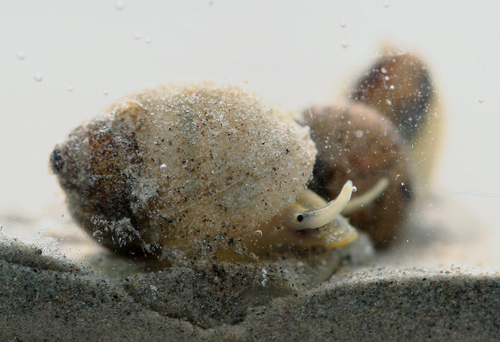
About Lithoglyphus naticoides (C.Pfeiffer, 1828)
This species is named naticoides because the shape and general appearance of its shell and operculum resemble those of marine moon snails in the family Naticidae, such as the Northern moon snail. The shell is globular, with a color that ranges from light grey to greenish yellow to dark. It has 4.5 to 5 whorls, and the last whorl is the most prominent. Shell dimensions are typically 7–10 mm by 7–10 mm; alternate measurements put shell width at 6.5–8 mm and shell height at 7–9 mm. The snail has a broad foot, and males are often smaller than females. During the Pliocene, Lithoglyphus naticoides ranged from Western Europe to Western Siberia. During cooler eras, its distribution shrank to the Ponto-Azov area, and its current natural distribution type is Pontic. Its native range is restricted to Black Sea rivers and the Danube, extending up to Regensburg, covering areas from southeastern to central Europe. It has also been artificially introduced to other parts of Europe. After 1800, it was introduced to the Elbe and Rhine regions. After 1960, it became nearly extinct in central Europe due to water pollution. This species has been recorded in the following countries: Western Europe: Netherlands, France; Central Europe: Austria, Czech Republic (endangered in Moravia), Germany (highly endangered, classified as Stark gefährdet, and critically endangered in Sachsen-Anhalt and Baden-Württemberg), Poland (endangered, non-indigenous), Slovakia; Eastern Europe: Latvia, Lithuania, Belarus, Ukraine, Russia. It was first found in the Volga River delta in 1971, and has since spread upstream to inhabit reservoirs including the Volgograd Reservoir, Saratov Reservoir, Kuybyshev Reservoir, and Gorky Reservoir. In Asia, it occurs in Bukhtarminskoe Reservoir on the Irtysh River in Kazakhstan, where it reaches population densities of 700 snails per square meter. It has also been recorded in Turkey and in the North American Great Lakes. This snail lives in rivers, lakes, channels, and reservoirs. In rivers, it occupies sites with low water current, found on solid muddy soils and around stones. It requires environments with high oxygen and calcium carbonate content. According to a 1949 record by Krause, population densities can reach up to 3,300 snails per square meter. It can tolerate salinity up to 3 ‰. Lithoglyphus naticoides feeds on diatoms and green algae. Its life cycle takes one year, reproduction occurs mainly in July, and its maximum lifespan is 4–5 years. The morphology of its egg capsules was described by Berezkina in 2010. This species acts as the first intermediate host for the parasites Nicolla skrjabini (Iwanitzki, 1928) and Apophallus muehlingi (Jägerskiöld, 1898), and as an intermediate host for Apophallus donicus (Skrjabin & Lindtrop, 1919). Perforated shells of Lithoglyphus naticoides were found as a head decoration in a Neolithic grave in Lower Austria.

