About Lithodytes lineatus (Schneider, 1799)
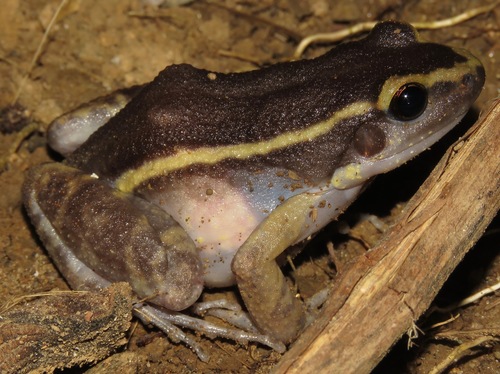
Female Lithodytes lineatus grow to between 38 and 52 mm (1.5 to 2.0 in) in length, while males are slightly smaller. This frog has a slender body and a blunt snout. Its overall base color is black, distinguished by a pair of yellow lateral stripes that run from the snout all the way to the groin, where a red or orange patch is located. The limbs are brown with black banding. L. lineatus resembles the brilliant-thighed poison frog Allobates femoralis, Ameerega hahneli, and the Amazonian poison-dart frog Ameerega picta. By mimicking the appearance of these toxic species, L. lineatus avoids detection by predators. L. lineatus is native to tropical South America. Its range covers the Orinoco basin and the Amazon basin, and it can be found in Colombia, Venezuela, the Guianas, Ecuador, Peru, Bolivia, and Brazil, extending as far as the state of Tocantins. Its natural habitats are subtropical or tropical moist lowland forests, moist savanna, and intermittent freshwater marshes, occurring at altitudes from sea level up to 1,800 m (5,900 ft) above sea level. The species can be found under logs, within leaf-litter, and in other concealed positions on the forest floor. L. lineatus breeds in temporary pools, where females build foam nests and lay between 100 and 300 eggs. The female guards the developing eggs until the tadpoles hatch. This frog is often found living in association with the leaf-cutter ant Atta cephalotes. Male L. lineatus have been observed calling from inside active ant nests, and appear to remain unharmed by the ants. While ants typically kill intruders entering their nests, frogs captured near nest entrances carry a noticeable aromatic odor; researchers hypothesize that this odor prevents ants from attacking the frogs. In one observation, four male frogs called synchronously from inside a large ant nest, producing a call made of a series of brief whistles at a rate of approximately 85 per minute. Examination of another ant nest revealed various internal passages and a wide vertical tunnel that descends to the water table, with L. lineatus foam nests attached to roots on the tunnel wall and tadpoles at different developmental stages in the underground pool. Ants were also moving through these same tunnels. The frogs gain multiple benefits from this association: they get a well-protected breeding location and remain safe from predation. L. lineatus eggs require protection from predatory animals including spiders, beetles, wasps, snakes, and turtles that hunt terrestrial frog eggs. Additionally, ant nests provide a stable microenvironment with higher humidity than surrounding areas, which is thought to be essential for reproduction and optimal for frog egg development. It is unclear whether the ants gain any benefit from this arrangement, but an examination of stomach contents from two L. lineatus individuals showed that their diet consists of earthworms, crickets, isopods, and insect larvae, with ants making up less than 10% of their consumed food. The frogs' low level of ant consumption might benefit ants and be tolerated by the species, acting as a form of population control for the ants. Another possibility is that these frogs consume the competitors, enemies, and predatory insects of Atta cephalotes, which would decrease competition and potentially benefit the ant colony. Atta ants primarily feed on fungal symbionts that grow inside their nests and do not need other food sources, so the ants do not consume frog eggs in this inter-genus association, eliminating this as a concern. Male L. lineatus have also been observed calling at the entrance and inside of Atta laevigata nests, and juvenile frogs have been seen emerging from Atta sexdens nests. Analysis of the chemical composition of anuran skin secretions is common and important, because substances found in these secretions may have potential use as antimicrobials. Benzocaine, a local anesthetic, is often orally administered in lethal doses to humanely euthanize anurans for research. However, the use of this anesthetic temporarily became a source of concern in 2018, after benzocaine was found in the skin extracts of the species Melanophryniscus moreirae and Lithobates clamitans, which could potentially invalidate many compositional studies of frog skin extracts. Fortunately, a 2020 study confirmed that orally administered gel benzocaine did not lead to any detection of benzocaine in the skin of L. lineatus. Liquid-form benzocaine can cause false positive results, but gel-form benzocaine applied at toxic doses inside the mouths of frogs does not alter the chemical composition of frog skin extracts and should not confound any assays performed on skin extracts.