About Lithobius variegatus Leach, 1814
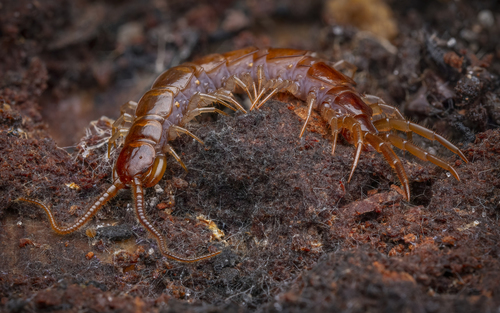
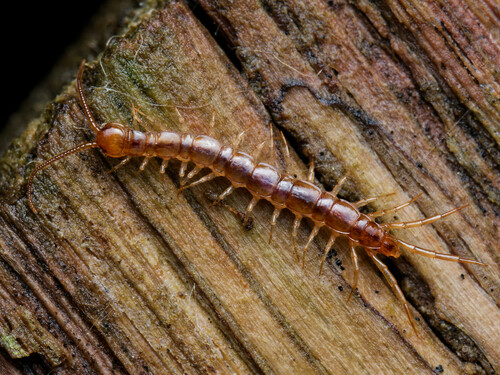
Lithobius variegatus Leach, 1814 is a species of centipede native to Europe, and is commonly known as the common banded centipede or simply the banded centipede. This species can be told apart from its close relative Lithobius forficatus by the prominent purple or brown rings that encircle its legs. It hunts small invertebrate prey, including woodlice species Philoscia muscorum, Oniscus asellus, Porcellio scaber, and Androniscus dentiger, and millipede species Polydesmus angustus and Tachypodoiulus niger. In turn, Lithobius variegatus is preyed on by bird species such as magpies and blackbirds. For a long period, researchers believed L. variegatus was endemic only to the British Isles, but populations were later found in the Channel Islands, Brittany, northwestern Spain, and northern Portugal. There are also recorded observations of this species from southern Italy, Morocco, and Tunisia. This distribution places L. variegatus as a clear example of a member of the Lusitanian fauna, a group of species that occur in the western Mediterranean region and range north to the British Isles, while being absent from most of northwestern Europe. Lithobius variegatus includes one subspecies, L. v. rubripes, which was previously classified as its own separate species. This subspecies has a wider distribution across Western Europe, and does not have the distinct leg banding pattern found on the main species.