About Lithobius melanops Newport, 1845
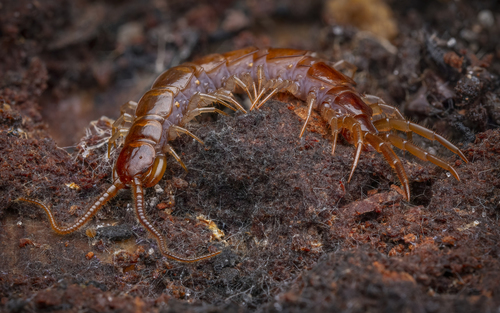
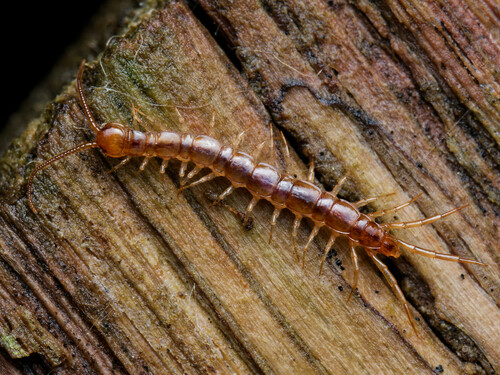
Lithobius melanops Newport, 1845 individuals have a body length ranging from 11 millimeters to 17 millimeters. Their bodies are fusiform and dorsoventrally flattened, with a width ranging from 1.5 to 2.5 millimeters. This species is typically pale brown, with a darker longitudinal stripe running down the center of its dorsal side. Reliable identification of this species requires the presence of all of its key distinguishing features: 32 to 44 antennal articles, 10 to 13 ocelli with a much larger posterior ocellus, 2+2 forcipular teeth (rarely 3+3), 3 to 6 round pores on each hind coxa, backwards projections on tergites 9, 11 and 13, and a double claw (one smaller, one larger) on the 15th leg. This species has been reported from many regions across the world. In Europe, it has been found in Iceland, Ireland, the United Kingdom, Spain, France, Belgium, the Netherlands, Luxembourg, Switzerland, Germany, Denmark (including the Faroe Islands), Norway, Sweden, Finland, Austria, Czechia, Slovakia, Poland, Hungary, Slovenia, Croatia, Bosnia-Herzegovina, Italy, Romania, Bulgaria, Latvia, Lithuania, Ukraine, and Russia. In Africa, it occurs in Morocco, the Azores, Madeira, the Canary Islands, and Saint Helena, and has also been reported from South Africa. In North America, it is found in the United States and Canada, and has been reported from Mexico. In South America, it has been reported from Ecuador, Brazil, and Argentina. In Asia, it has been reported from Israel, the Asian portion of Russia, and Kazakhstan. This species is also reported to occur in New Zealand.