About Lithobates virgatipes (Cope, 1891)
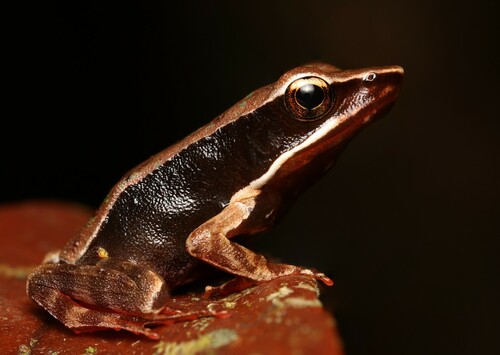
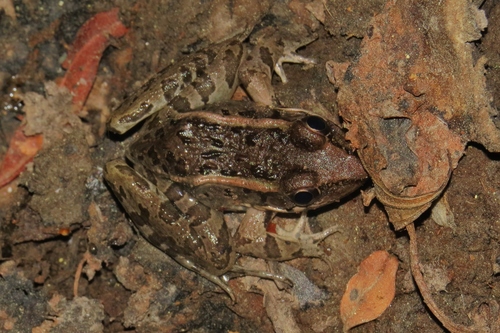
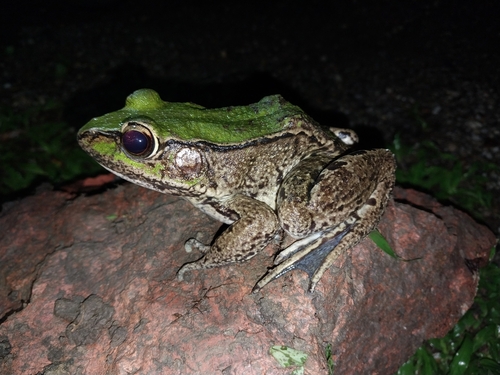
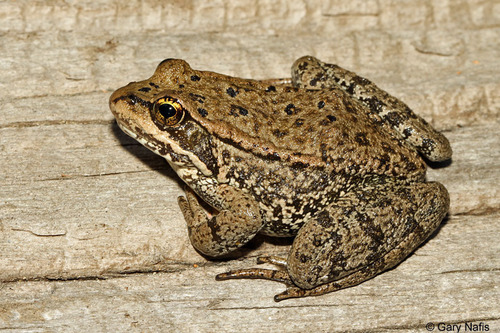
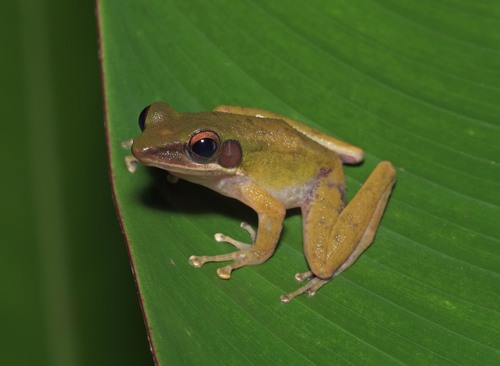
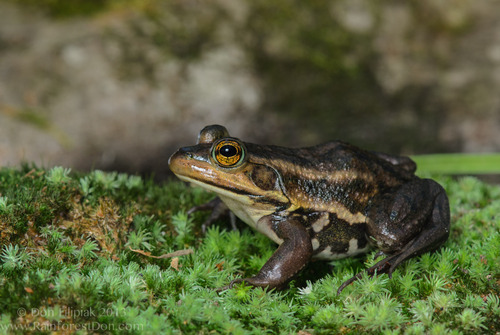
Identification: Carpenter frogs (Lithobates virgatipes) are a medium-sized frog species, with fully grown adults measuring 4.1 to 6.6 centimeters. They are entirely brown, with two yellow stripes running along each side of their back, a gray tail, and a white or yellow underside. Unlike most other frogs, the webbing on their toes does not extend all the way to the tip of their longest toe. When inflated, their throat pouch is spherical in shape. Carpenter frogs are ectothermic and heterothermic, with bilateral symmetry. Their common name comes from their distinctive call, which sounds like a carpenter hammering. Habitat: This species is native to the Atlantic coastal plains of the United States, ranging from the pine barrens of New Jersey down to northern Georgia. It also occurs in Florida, though it is not common there. Carpenter frogs are almost exclusively aquatic, rarely found on land, and have adapted to survive in acidic waters. They have been observed in cypress ponds, interdunal swales, tupelo swamps, acid swamps, and canals. They are strongly associated with sphagnum mats and other aquatic vegetation in the coffee-colored waters of pine savanna bogs and ponds, and are sometimes nicknamed "sphagnum frogs" due to their frequent occurrence in relatively acidic waters abundant with sphagnum or other vegetation. They rely on aquatic vegetation in shallow waters for both protection and breeding, and their brown coloration provides effective camouflage in these tea- or coffee-colored waterways. Reproduction: Carpenter frogs are prolonged breeders, with a breeding season that lasts 2 to 3 months. The breeding season typically begins when warm weather arrives in late April, and continues through late July or early August. During this time, males maintain territories with a median radius of 1 meter, and produce mating calls on most nights. Calling activity takes place between sunset and sunrise, and peaks near midnight. Call intensity varies with body size: smaller males have higher-pitched calls of lower intensity than larger males. Carpenter frogs produce five distinct call types, each used for a different social interaction. After mating, females lay globular egg masses containing 200 to 600 eggs, which they anchor to underwater vegetation at depths of up to 8 inches. Life cycle: Tadpoles hatch from their eggs approximately one week after being laid, and remain in the tadpole stage for around one year. Metamorphosis into juvenile frogs occurs between August and September.