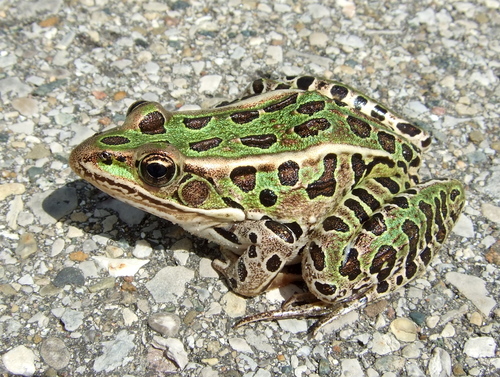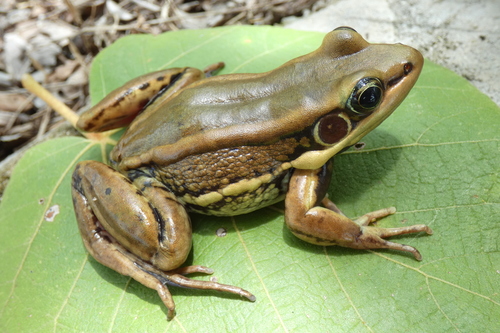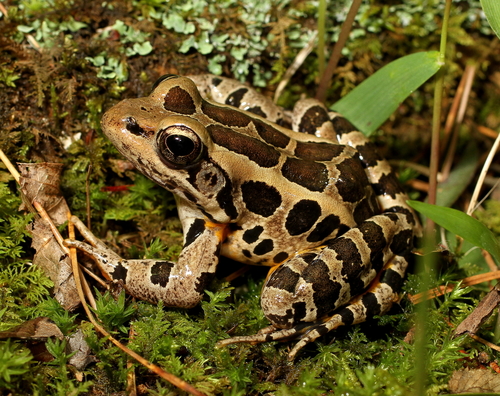
About Lithobates palustris (LeConte, 1825)
The pickerel frog, scientifically named Lithobates palustris (formerly Rana palustris), is a small North American frog. It is recognizable by the seemingly 'hand-drawn' square markings on its dorsal back. The pickerel frog's range extends west from most of Wisconsin, southeastern Minnesota, and eastern Iowa, through Missouri, down to eastern Texas. To the east, it stretches through northern Louisiana, most of Mississippi, northern Alabama, Georgia, and South Carolina, reaching the Atlantic coast. Its northern range extends into Canada, covering the southern regions of Ontario, Quebec, New Brunswick, and Nova Scotia; individuals have also been spotted in Newfoundland and Labrador, Canada. Across midwestern states, the species' distribution is spotty, so a local field guide should be consulted for detailed range information in specific areas. Pickerel frogs live in a variety of habitats. Northern populations prefer areas near cold, clear water, including rocky ravines, bogs, and meadow streams, and can also be found around heavily wooded lakes and rivers. A study of Canadian amphibians found that pickerel frogs are negatively associated with young forest stands. Southern populations within the species' range prefer warmer waters, such as those found in Coastal Plain and floodplain swamps. They are most often seen along the edges of streams, lakes, rivers, and even flooded ditches. During winter, pickerel frogs hibernate under silt and debris in their aquatic habitats, and are generally only active between April and October. When possible, this species uses caves as thermal refugia during the coldest months of the year. The pickerel frog is a trogloxene species, meaning it occurs in caves but cannot complete its full life cycle there. While the species is most abundant in caves during winter, it can be active deep inside caves at almost any time of year. When temperatures drop too low, the species occupies clustered hibernacula, which are commonly grouped near each other in the center of caves. Pickerel frogs may also use these same caves to escape heat during hot summers. For breeding, pickerel frogs still prefer cool, clear water. They can breed in both temporary and permanent ponds, but appear to favor ponds with long to permanent water retention. In Rhode Island specifically, pickerel frog tadpoles and egg masses have been found in well-vegetated permanent manmade rural ponds, farm ponds, and urban ponds surrounded by roads. Pickerel frogs typically emerge from hibernation around mid-April, with most individuals arriving at breeding ponds by early May. No fall reproduction has been recorded for this species. At breeding ponds, pickerel frogs are usually found in large groups in the water. Their mating behavior is not notably different from that of other ranid frogs. Males initiate breeding by emitting low-pitched calls, which are often so low that they go unnoticed during standard calling surveys. Males can change their call type depending on interactions with other males, and are known to call while submerged, which usually makes their calls inaudible in open air. Underwater calls vary between different populations, which suggests that under some conditions, vocalizing underwater is more beneficial than calling into open air. Pickerel frogs reproduce via external fertilization while engaging in a mating behavior called amplexus. Sometimes amplexus lasts more than one or two days, even after the female has finished depositing her eggs.