About Lithobates kauffeldi (Feinberg, Newman, Watkins-Colwell, Schlesinger, Zarate, Curry, Shaffer & Burger, 2014)
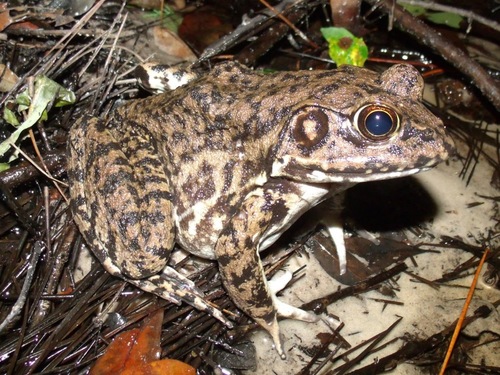
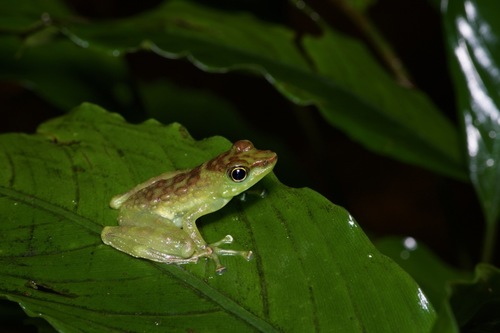
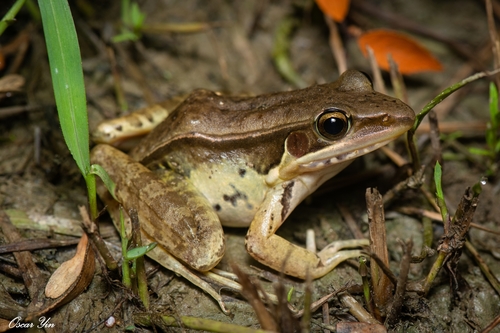
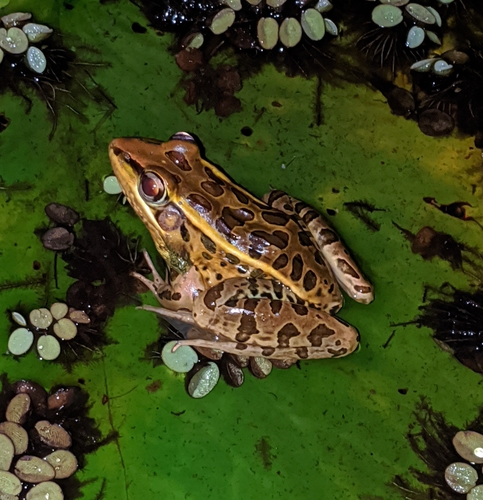
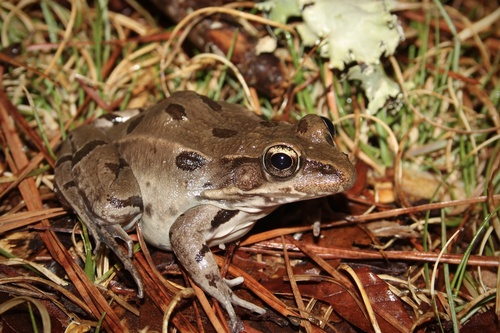
Lithobates kauffeldi, commonly known as the Atlantic Coast leopard frog, has a body color that ranges from mint-gray to light olive green, with irregularly distributed brown spots across its back and legs. Dark stripes run along its head from the snout, it has large eyes, and strong legs built for leaping. Individuals' body color changes between day and night and across seasons: most individuals take on darker tones at night, and lighter hues during the day. Adult males have large vocal sacs on either side of the head, which they use to produce mating calls. It is difficult to distinguish Atlantic Coast leopard frogs from Southern leopard frogs. Key traits that set the Atlantic Coast leopard frog apart from the Southern leopard frog include no white spot on the tympanum, a femoral reticulum (inner thigh) that is mostly dark with unconnected light patches, a blunter snout, and duller overall coloration. However, there is substantial overlap in these characteristics between the two species, and no single physical trait can reliably tell them apart. The most reliable distinguishing feature of the Atlantic Coast leopard frog is its mating call. The call of the Atlantic Coast leopard frog is a single, distinct "chuck" sound, unlike the repeated "ak-ak-ak" of the Southern leopard frog or the "snore" of the Northern leopard frog. L. kauffeldi occurs in nine states along the northeastern coast of the United States, spanning from central Connecticut to northeastern North Carolina. The species' north-south range is roughly 780 kilometers long, and extends about 100 kilometers inland from the Atlantic shoreline. The range narrows as it extends southward, and runs mostly along the I-95 corridor. The species is thought to have been extirpated from most of Connecticut, the Hudson Valley, and Long Island. The Atlantic Coast leopard frog lives alongside the northern leopard frog in Connecticut, and alongside the southern leopard frog from New Jersey through North Carolina. It is known to hybridize with these two species where their ranges meet. For a long time, this species remained undiscovered because of its physical and habitat similarity to both the northern and southern leopard frog. The Atlantic Coast leopard frog uses different habitats across the extent of its range. In the northern part of its range, from Delaware through Connecticut, it tends to live in large coastal or riparian wetlands, such as marshes and wet meadows. These habitats typically contain clear, shallow water, and the species is commonly associated with plants including Phragmites australis, cattails, and river shrubs. In Virginia and North Carolina, it primarily lives in riparian cypress-gum swamps. Compared to the sympatric Southern leopard frog, which uses a wider variety of habitats, the Atlantic Coast leopard frog is a habitat specialist. Across its range, the Atlantic Coast leopard frog also occupies fragmented wetland habitats in many urban areas, including Staten Island, the New Jersey Meadowlands, Philadelphia, and the Wilmington-New Castle area of Delaware.