About Lithobates clamitans (Latreille, 1801)
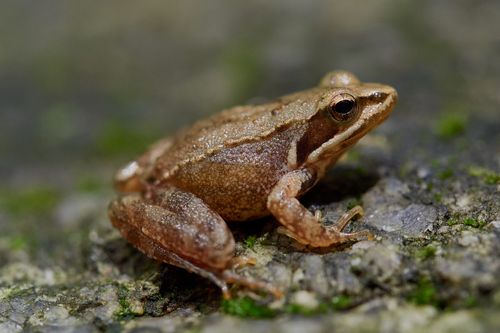
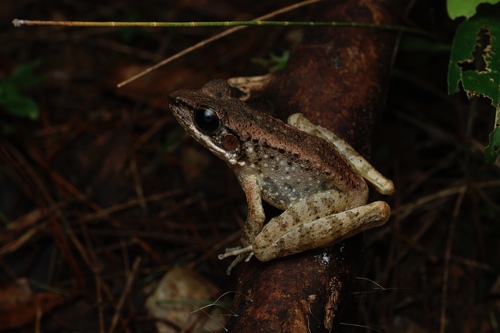
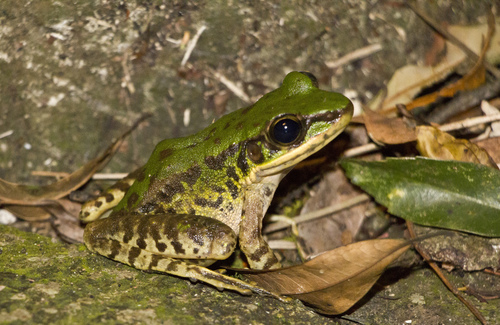
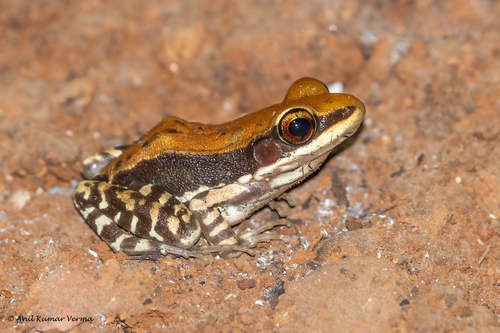
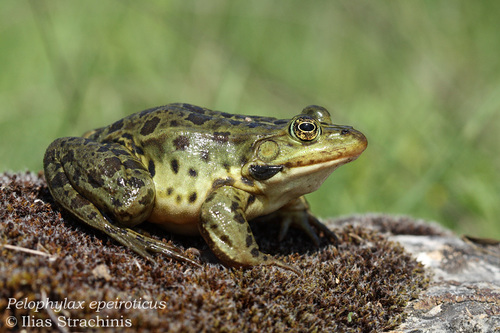
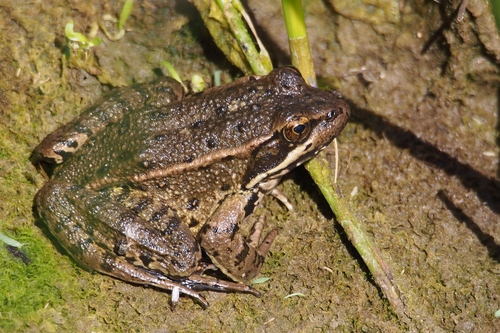
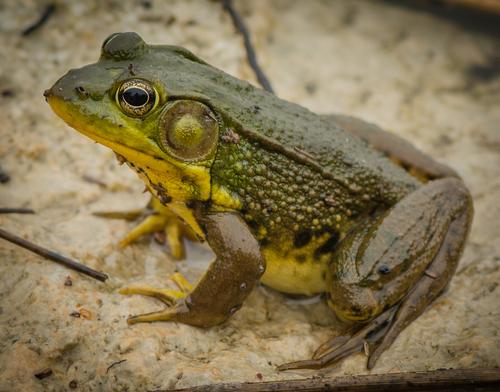
This mid-sized true frog species, commonly called the green frog, has an adult body length (snout to vent, excluding hind legs) of 5–10 cm (2.0–3.9 in), and a typical adult body weight of 28 to 85 g (0.99 to 3.00 oz). This species shows sexual dimorphism across several traits: mature females are generally larger than males; male tympanums are twice the diameter of the eye, while female tympanum diameter is roughly equal to eye diameter; and breeding-condition males have bright yellow throats. Prominent seam-like skin folds called dorsolateral ridges run down the sides of the back, a trait that distinguishes green frogs from bullfrogs, which completely lack these ridges. Most green frogs have green heads, while their bodies are brown, gray, or dark green. The extent of green coloration varies between individuals: some only have green on the sides of their head, while others are green all the way down their back. Their belly is white with black mottling. Green frogs darken their color on colder days to help absorb heat. A genetic mutation called axanthism that prevents yellow pigment production can sometimes make green frogs blue, since yellow and blue pigments normally combine to produce the species' typical green coloration. Green frog tadpoles are olive green, with an iridescent creamy-white underside. Metamorphosis can happen within the same breeding season eggs are laid, or tadpoles may overwinter to metamorphose the following summer. Green frogs are always associated with bodies of water, and can be found across a range of habitats. They live along the margins of shallow freshwater ponds, roadside ditches, lakes, swamps, streams, and also vernal pools and other temporary water bodies, though they occur less often in temporary habitats than other frog species. They maintain small home ranges around these water sources, spend roughly one third of their time foraging (especially in areas with abundant leaf litter and dense vegetation), and return to water to take refuge. Human development of roads, buildings, other infrastructure, and agricultural land has destroyed and impacted their native habitat. However, if high-quality abundant habitat exists nearby, green frogs can flee deforestation events, and are somewhat tolerant of this habitat destruction. When fleeing habitat destruction, green frogs primarily move between three distinct types of aquatic habitat: ephemeral wetlands, streams, and swamps. Green frogs select habitats with increased soil moisture, fine woody debris, and fewer trees, with water cover being the most important factor, reflecting their preference for areas near water and open environments for survival. This widespread species is native to North America, occurring mainly across eastern North America, ranging from the St. Lawrence River Valley in southeastern Canada to Northern Florida and Eastern Texas. Multiple threats are contributing to amphibian population declines, with current extinction rates estimated to be up to 211 times the natural background extinction rate; contributing threats for green frogs include habitat destruction, deforestation, climate change, disease, and chemical contaminants. Water and air temperatures play a major role in the timing and rates of this species' breeding, larval development, time to metamorphosis, size at metamorphosis, growth, and other physiological traits. Experimental data confirms that organisms including green frogs are more sensitive to chemical contaminants when temperature varies, explaining how chemical contamination heavily impacts the frogs' development. Chloride specifically affects green frog development: high chloride exposure can cause many larvae to develop broken tails, swollen body cavities, loss of pigment, and behavioral abnormalities. As environmental temperature increases, chloride-exposed frogs experience faster mortality and significantly higher hazard compared to unexposed control groups. This confirms that temperature directly alters chemical sensitivity, making green frog habitats more dangerous and impacting the species' development. Data from the Maryland Biological Stream Survey shows that stormwater ponds, a major green frog breeding habitat in Maryland, can reach chloride concentrations as high as 3250 mg/L, demonstrating how multiple interacting habitat factors impact green frog survival rates. Various herbicides and pesticides can also harm green frogs, due to the species' permeable skin. For territorial defense, male green frogs often engage in physical wrestling matches with one another. Resident male frogs also create loud splashing noises by jumping up and down in the water, or by sitting in one spot and rapidly kicking their hind legs. This combination of jumping and splashing serves multiple purposes: males leap high out of the water to patrol territory borders and locate intruders, then produce loud splashing to mark their territory and scare off intruders. Splashing displays are also triggered when intruders enter a territory, and are performed by victorious males that are pursuing opponents, further demonstrating this behavior as a way for green frogs to assert dominance. If advertisement calls and splashing do not deter an intruder, the resident male will use more aggressive behaviors: he will jump at the intruder, chase them away, or attack and immediately clasp the intruder around the head, waist, or a leg. Most attacks are directed at other competing males during territorial defense, but some attacks target females. This happens because resident males cannot visually distinguish between females and males, and may mistake a female passing through their territory for an intruding male. As a result, females use a similar posture to satellite males when moving through a resident male's territory. Most interactions between male green frogs rely on splashing and vocalizations to scare off intruders or satellite males. Wrestling bouts only occur when two males are evenly matched competitors for a territory. At the start of a bout, the two males approach each other in a high posture to signal their equal status. When they are only a few centimeters apart, they tip their heads at an angle to expose their bright yellow throats to their opponent. Wrestling begins shortly after, with each frog jumping, swimming, or splashing at the other to try to secure a strong grip on their opponent. Eventually, after each frog clasps the other around the pectoral region, they engage in a pushing contest until one is pushed onto its back. Once an opponent falls, the dominant male holds his opponent under water and squeezes until the opponent concedes defeat and frees itself from the hold. Male green frogs reach sexual maturity at one year of age, while females reach maturity at either two or three years of age. Males establish breeding territories and maintain them for the entire spring-to-summer breeding season, which varies in timing based on location and temperature. There is a strong positive correlation between temperature and detection of breeding activity. During the breeding season, females lay an egg clutch of 1000 to 7000 eggs arranged in surface films 15–30 cm in diameter, which are attached to vegetation in shallow water to protect the eggs from predators. Females may occasionally lay two clutches of eggs in a single breeding season. Mature females reach a maximum snout-to-vent length of 98–105 mm. Females ready to mate typically enter male territories and hold a low posture to signal their subordination to the resident male. Even so, females actively select mates, and the mating selection process usually takes 2 to 3 days. Females tend to favor territorial males with strong mating calls, a preference driven by the goal of higher reproductive success and passing more favorable traits to offspring. When a female is a few centimeters in front of the male, she backs her body into the male, and once physical contact is made, the male clasps the female and fertilization begins. In some cases, females are not clasped because the stimuli that trigger amplexus (the male clasping the female from the back) do not occur. After fertilization, almost all eggs are deposited within the resident male's territory, rather than a satellite male's territory. This indicates that female polyandry is not common in this species, and placing eggs in a resident male's territory improves offspring protection. Research has documented sex reversal in wild green frogs living in both contaminated suburban backyard ponds and relatively undisturbed forested ponds. This sex reversal appears to be a natural condition, but it is currently unknown whether sex-reversed wild green frogs can breed. After eggs are deposited in the resident male's territory, development begins. Green frog larval life typically lasts between 70 and 360 days, depending on what time of year the eggs were laid. For adult green frogs, the main growth season, when snout-to-vent length increases the most, runs from mid-May to mid-September. This growth pattern correlates with mean monthly temperature and the amount of time temperatures are favorable for feeding. Sexual maturity is reached around one year after metamorphosis, but frogs do not become sexually active until the year after they reach sexual maturity. There is no size-based sexual dimorphism in fully mature green frogs.