About Lithobates catesbeianus (Shaw, 1802)
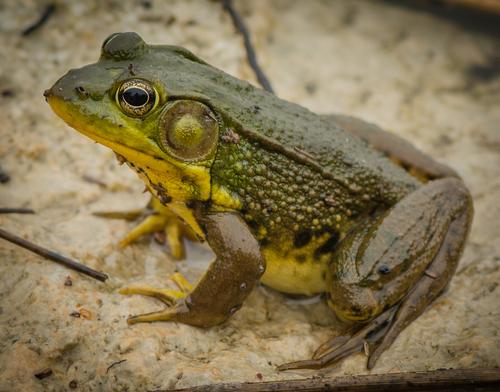
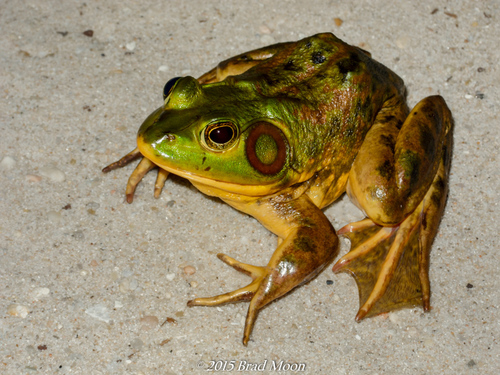
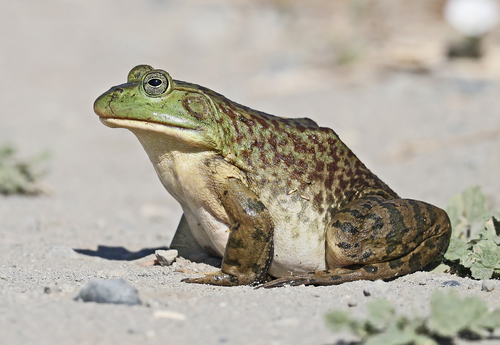
The bullfrog, scientifically named Lithobates catesbeianus (Shaw, 1802), has an olive-green base color on its dorsal (upper) surface, which may be solid or marked with grayish brown mottling and banding. Its ventral (under) surface is off-white, with blotches of yellow or gray. There is often a clear color contrast between the green upper lip and pale lower lip. Its teeth are very small and only suited for grasping prey. It has prominent eyes with brown irises and horizontal, almond-shaped pupils. The tympana (eardrums) are easily visible just behind the eyes, and are enclosed by dorsolateral skin folds. The limbs are gray, either blotched or banded; the fore legs are short and sturdy, while the hind legs are long. The front toes are not webbed, and all back toes have webbing between digits except the fourth toe, which is unwebbed. Bullfrogs are sexually dimorphic: males are smaller than females, have yellow throats, and have tympana larger than their eyes, while females have tympana about the same size as their eyes. Bullfrogs typically measure 3.6 to 6 inches (9 to 15 cm) in snout-to-vent length. They grow quickly in their first eight months of life, usually increasing in weight from 5 to 175 g (0.18 to 6.17 oz). Large mature individuals can weigh up to 500 g (1.1 lb), and rare records note individuals reaching 800 g (1.8 lb) and 8 inches (20 cm) snout-to-vent. The American bullfrog is the largest true frog species native to North America. The bullfrog is originally native to eastern North America, where it is common in every U.S. state east of the Mississippi River. Its natural range extends from the eastern Canadian Maritime Provinces west to Idaho and Texas, and north to Michigan (including the Upper Peninsula), Minnesota and Montana; it is largely absent from North Dakota. It has been introduced to Nantucket island, and to parts of the western U.S. including Arizona, California, Colorado, Hawaii, Idaho, Nevada, New Mexico, Oregon, Utah, Washington and Wyoming, where it is considered an invasive species. Conservation concerns note that it may outcompete or prey on native reptile and amphibian species, disrupting local ecological balance. It has also been introduced to Hawaii, South America, Asia, the Caribbean, and Europe for purposes including frog farming and biological control of other species. It is very common on the U.S. West Coast, especially in California, where it is thought to threaten the California red-legged frog and is considered a contributing factor to the decline of this vulnerable species. It has been recorded feeding on young of several snakes, including the threatened, California-endemic giant garter snake. In early 2023, the Utah Department of Natural Resources began sharing social media tips for catching and cooking bullfrogs to encourage residents to help control the growing invasive population by harvesting them for food. Other introduced regions for the bullfrog include extreme southern British Columbia (Canada), almost every state in Mexico, as well as Belgium, Cuba, the Dominican Republic, Haiti, Italy, Jamaica, the Netherlands, Puerto Rico, Argentina, Brazil, China, Colombia, Japan, South Korea, Uruguay and Venezuela. Most introductions have been intentional, either to provide a human food source or as biological control agents. Unintentional introductions also occur via escapes from breeding facilities, scientific research sites, or from captive/ pet releases. Conservationists are concerned that the bullfrog is relatively immune to chytridiomycosis (chytrid fungus), a lethal fungal infection that has severely harmed many other frog species. As an asymptomatic carrier, the bullfrog may spread the fungus to more susceptible native frog species when it invades new territories. In ecology, bullfrogs are an important prey source for many birds (especially large herons), North American river otters (Lontra canadensis), predatory fish, and occasionally other amphibians. Predators of adult American bullfrogs range from 150 g (5.3 oz) belted kingfishers (Megaceryle alcyon) to 500 kg (1,100 lb) American alligators (Alligator mississippiensis). Bullfrog eggs and larvae are unpalatable to many salamanders and fish, but the high activity level of tadpoles makes them noticeable to predators not deterred by their bad taste. Humans hunt bullfrogs as game and eat their legs. When threatened, adult bullfrogs escape by splashing and leaping into deep water. Trapped individuals may squawk or let out a piercing scream that can startle attackers enough to allow escape. An attack on one bullfrog alerts nearby other bullfrogs to danger, and all will retreat to the safety of deep water. Bullfrogs may be at least partially resistant to the venom of copperhead (Agkistrodon contortrix) and cottonmouth (Agkistrodon piscivorus) snakes, though these species, along with northern water snakes (Nerodia sipedon), are known natural predators of bullfrogs. As an invasive species, multiple traits of L. catesbeianus boost its competitive ability. Its generalist diet lets it feed in many different environments. Stomach content analysis found that adult bullfrogs regularly eat predators of bullfrog young, including dragonfly nymphs, garter snakes, and giant water bugs. This reduces the effectiveness of natural ecological population controls on bullfrog juveniles in invaded areas. L. catesbeianus also shows immunity or resistance to the antipredator defenses of other organisms: stomach content analysis from New Mexico bullfrog populations shows they regularly eat wasps with no conditioned avoidance of stingers; along the Colorado River, stomach contents show they can tolerate the uncomfortable spines of stickleback fish; there are also reports of American bullfrogs eating scorpions and rattlesnakes. Analysis of the American bullfrog's realized niche at various sites in Mexico, compared to niches of endemic Mexican frogs, suggests the American bullfrog is capable of niche shift, and can threaten many endemic Mexican frog species even when they are not currently competing directly. For human use, the American bullfrog serves as a food source, especially in the Southern and some Midwestern areas of the United States. Traditional hunting methods involve paddling or poling silently through ponds or swamps at night via canoe or flatboat; once a frog's call is heard, a light is shined on the frog to temporarily stop it from moving, and it will not jump into deeper water if approached slowly and steadily. When close enough, the frog is gigged with a multiple-tined spear and brought aboard. Bullfrogs may also be stalked on land, with great care taken not to startle them. In some U.S. states, breaking the skin during capture is illegal, so grasping gigs or hand capture are used. Like most frogs, only the hind legs are commonly eaten; when cooked, they resemble small chicken drumsticks, have a similar flavor and texture, and can be prepared the same way. Commercial bullfrog farming in near-natural enclosed ponds has been attempted, but faces many difficulties. Though pelleted feed exists, bullfrogs usually will not eat artificial diets, and providing enough live prey is challenging. Disease is also a common problem even when sanitary conditions are carefully maintained. Other challenges include predation, cannibalism, and poor water quality. The large, powerfully leaping frogs inevitably escape, and can then harm native frog populations. Countries that export bullfrog legs include the Netherlands, Belgium, Mexico, Bangladesh, Japan, China, Taiwan, and Indonesia; most of these frogs are wild-caught, though some are captive-raised. The United States is a net importer of frog legs. During the Great Depression, businessman Dr. Albert Broel promoted bullfrog farming as a way for people facing economic hardship to earn extra money by raising and selling bullfrogs. He published instructional manuals including Frog Raising for Pleasure and Profit, and offered in-person training, plus a guarantee to purchase all adult frogs that independent breeders raised to adult weight. The scheme was ultimately unsuccessful for the same reasons listed above, but its business model of outsourcing livestock raising to independent farmers is still used today, especially in the poultry industry. The American bullfrog is also used as a dissection specimen in many biology and anatomy classes in schools around the world, and it is the official state amphibian of Missouri, Ohio, and Oklahoma.