About Litchi chinensis Sonn.
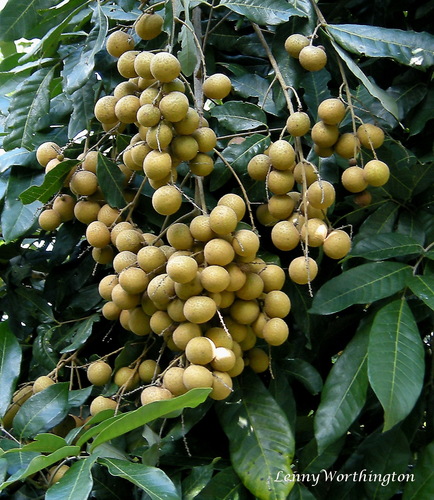
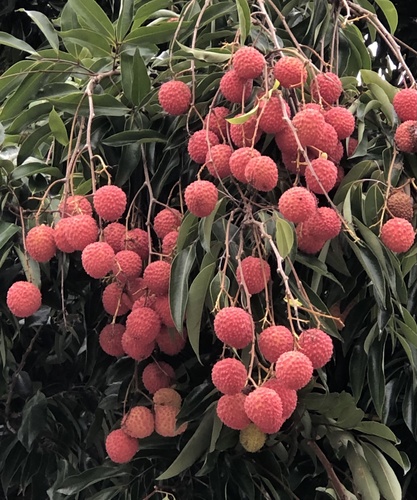
Lychee (pronounced LIE-chee, and also LEE-chee in the United States; scientific name Litchi chinensis; Chinese: 荔枝; pinyin: lìzhī; Jyutping: lai6 zi1; Pe̍h-ōe-jī: nāi-chi) is a monotypic taxon, and the only member of the genus Litchi in the soapberry family, Sapindaceae. Its fruit is edible, with a sweet, mildly tart flavor and a distinctive rose-like floral aroma. There are three distinct lychee subspecies: the most common is the Indochinese lychee, native to South China, Malaysia, and northern Vietnam; the Philippine lychee, called alupag or matamata locally, found only in the Philippines; and the Javanese lychee, cultivated in Indonesia and Malaysia. The lychee tree has been introduced across all of Southeast Asia and South Asia. Lychee cultivation in China has been documented since the 11th century. China is the world's main lychee producer, followed by India, Vietnam, other Southeast Asian countries, other South Asian countries, Madagascar, and South Africa. Lychee is a tall evergreen tree that produces small fleshy sweet fruits. The fruit has an outer pink-red, rough-textured soft shell. Lychee seeds contain methylene cyclopropyl glycine, which has caused hypoglycemia linked to encephalopathy outbreaks in undernourished children in India and Vietnam who consumed lychee fruit. In 1962, researchers confirmed that lychee seeds contain methylenecyclopropylglycine (MCPG), a homologue of hypoglycin A that causes hypoglycemia in both human and animal studies. From the end of the 1990s onward, unexplained encephalopathy outbreaks were documented, which only affected children in India (where the condition is called chamki bukhar) and northern Vietnam (where it is called Ac Mong encephalitis, after the Vietnamese word for nightmare ác mộng) during the May to June/July lychee harvest season. A 2013 investigation conducted by the U.S. Centers for Disease Control and Prevention (CDC) in India found that cases were linked to lychee fruit consumption, which causes noninflammatory encephalopathy with symptoms that mimic Jamaican vomiting sickness. Since admission blood sugar levels (hypoglycemia) below 70 mg/dL were common among undernourished children affected, and low blood sugar was linked to a poorer outcome (44% of all cases were fatal), the CDC classified the illness as hypoglycemic encephalopathy. The investigation linked the illness to toxicity from hypoglycin A and MCPG, and to undernourished children eating lychees (especially unripe ones) on an empty stomach. The CDC report recommended that parents ensure their children limit lychee consumption, and eat an evening meal to raise blood glucose levels enough to prevent illness. Education campaigns to reduce lychee-associated encephalopathy have been launched, some even before the toxicity mechanism was confirmed; for example, a campaign began in 1995 in China. Earlier studies incorrectly concluded that transmission could occur through direct contact with lychees contaminated by bat saliva, urine, or guano, or from other vectors such as insects living on lychee trees or sand flies, similar to transmission of Chandipura virus. A 2017 study found that pesticides used in lychee plantations may be responsible for cases of encephalitis and child deaths in Bangladesh. Lychees are widely grown in southern China, Taiwan, Vietnam, the rest of tropical Southeast Asia, the Indian subcontinent, and many other tropical regions around the world. They require a frost-free tropical climate, with temperatures that do not drop below −4 °C (25 °F). They also need high summer heat, rainfall, and humidity, and grow optimally in well-drained, slightly acidic soils rich in organic matter and mulch. There are around 200 existing lychee cultivars, with early-maturing and late-maturing forms suited to warmer and cooler climates respectively. In China, eight cultivars are primarily used for commercial production. Lychee trees are also grown as ornamental plants. The most common propagation method for lychee is air layering. To make air layers, a cut is made on a branch of a mature tree, the cut is covered with a rooting medium such as peat or sphagnum moss, the medium is wrapped in polyethylene film, and the cut is left to root. Once substantial rooting has occurred, the rooted layer is cut from the original branch and potted. According to traditional practice, girdling a lychee tree that produces little fruit will lead to higher fruit production. When growers open the central canopy of trees as part of training and pruning, stereo fruiting can be achieved, which increases orchard productivity. Lychees are commonly sold fresh in Asian markets. The red rind darkens to brown when the fruit is refrigerated, but this color change does not affect the fruit's taste. Lychees are also sold canned year-round. The fruit can be dried with the rind intact, after which the flesh shrinks and darkens.