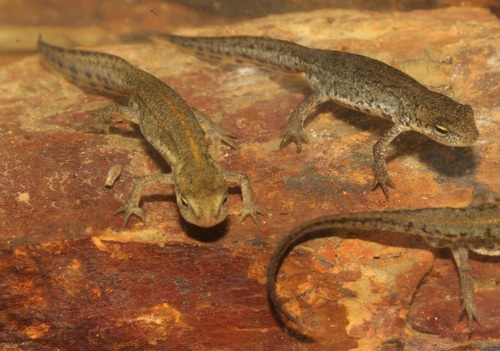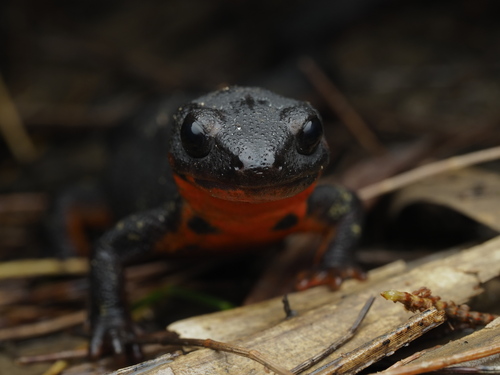
About Lissotriton vulgaris (Linnaeus, 1758)
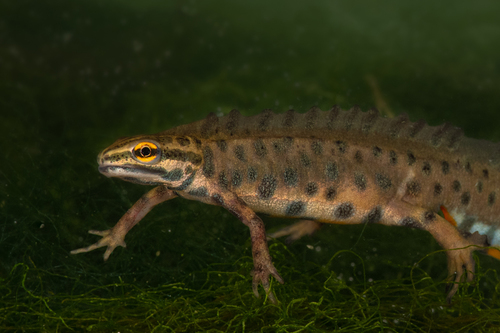
General characteristics: Adult male smooth newts (Lissotriton vulgaris) reach a head-to-tail length of around 9–11 cm (3.5–4.3 in), which is slightly larger than adult females that reach 8–9.5 cm (3.1–3.7 in). Adult body weight ranges between 0.3–5.2 g (0.011–0.183 oz), and weight decreases during the breeding season. The head is longer than it is wide, with two to three longitudinal grooves on its upper surface. The elongated snout is blunt in males and rounded in females. On land, the skin is velvety and water-repellent, while it becomes smooth during the aquatic phase. The skin contains mucus and toxin glands, and its upper layer is shed regularly. Outside the breeding season, both sexes are yellow-brown, brown or olive-brown. Males have dark, round spots, while females have smaller spots of the same color that sometimes form two or more irregular lines along the back. Males have an orange stripe along the underside of the tail, and an orange to white throat and belly marked with small dark, rounded spots; females have lighter coloration and smaller spots on these areas. Size and color vary with environment, and smooth newts tend to be smaller at northern latitudes. Albinistic and leucistic individuals have been recorded. The smooth newt is diploid, meaning it has two copies of each chromosome, with 24 chromosomes in total. Breeding characteristics: During the aquatic breeding season, males develop an uninterrupted skin crest that runs along their back and tail. This crest is 1–1.5 mm (0.039–0.059 in) high at mid-body, and grows higher along the tail. The male's tail also has a lower fin and a pointed end. The cloaca, the single opening for the digestive, urinary and reproductive systems, of breeding males is swollen, round and dark-colored. Depending on the subspecies, hindfeet have toe flaps that are more or less developed. Breeding season colors are generally more vivid than during the land phase. Dark spots grow larger, and the crest often has vertical dark and bright bands. There are five to seven longitudinal stripes on the head. The lower edge of the tail is red with a silver-blue flash and black spots. Females develop low straight tail fins, but do not develop crests or toe flaps, and have more drab coloration. Subspecies differ slightly in male secondary sexual characteristics: L. v. ampelensis has strongly developed toe flaps and a tail that tapers into a fine thread, without a distinct filament, and its body is slightly square in cross-section. L. v. meridionalis also has toe flaps and a pointed tail, with a smooth-edged crest and a square-shaped body. In the nominate subspecies, L. v. vulgaris, the crest is clearly denticulated, toe flaps are only weakly developed, and the body is round. Native range: The smooth newt has been described as "the most ubiquitous and widely distributed newt of the Old World". The most widespread is the nominate subspecies, L. v. vulgaris, whose native range extends from Ireland, where the smooth newt is the only native newt species, and Great Britain in the west, to Siberia and northern Kazakhstan in the east. Its northern limit reaches central Fennoscandia, while its southern limit runs through central France, northern Italy, the central Balkans and the dry Eurasian steppe of Ukraine and Russia. The subspecies L. v. ampelensis occurs only in the Carpathians of Ukraine and the Danube delta of northern Romania, and L. v. meridionalis is found in the northern half of Italy, southern Switzerland, Slovenia and Croatia. In the Carpathians, the smooth newt generally prefers lower elevations than the Carpathian newt. In the Balkans, the exact contact zones between the smooth newt and the Greek smooth newt and Schmidtler's smooth newt are not yet clear. In central Italy, where the range of the smooth newt subspecies L. v. meridionalis overlaps with that of the Italian newt (L. italicus), the Italian newt has been found to prefer a warmer and drier climate. Introduced range: The nominate subspecies, L. v. vulgaris, has been introduced to Australia, a continent that has no native salamander species. The smooth newt was available in the Australian pet trade until 1997, when it was declared a "controlled pest animal" due to invasion risk. The first wild sighting was recorded near Melbourne in 2011, and larvae were later found, confirming successful reproduction in the wild. There are concerns that the introduced smooth newt will have negative impacts on native Australian fauna, including predation on and competition with native frogs and freshwater invertebrates, as well as spreading toxicity and disease. The smooth newt could spread further in south-eastern Australia, where large areas have a suitable climate. Within Europe, the subspecies L. v. meridionalis has been introduced north of the Alps near Geneva, where it hybridizes with the native L. v. vulgaris. Habitat and ecology: The smooth newt is primarily a lowland species, though it can occasionally be found at elevations above 1,000 m (3,300 ft). This species has a wide habitat breadth, as it can thrive in a variety of terrestrial and aquatic environments. On land, it inhabits wooded areas, though dense coniferous woods are avoided, as well as more open areas such as damp meadows, field edges, parks, and gardens. It can tolerate human disturbance and urban environments, and hides under structures such as logs or stones or in small mammal burrows. Smooth newts may also climb vegetation, although the exact function of this behaviour is currently unknown. Freshwater breeding sites are usually exposed to sunlight, free of fish, and hold stagnant water for at least three months of the year. They are typically close to other similar bodies of water, and have shallow areas with abundant aquatic plants. Breeding sites can range in size from small puddles to larger ponds or shallow sections of lakes. Water quality is not a strong limiting factor, as the species tolerates pH values ranging from 4 (more acidic) to 9.6 (more alkaline). In Germany, smooth newts have even been found in slightly brackish water. They often share breeding sites with other amphibians, including other newt species. For example, in northern France, ponds have been recorded that host five newt species: smooth, palmate, alpine, northern crested and marbled (T. marmoratus) newts. Reproduction: Migration to breeding sites can begin as early as February, but in the northernmost parts of the range and at higher altitudes, migration may not start before summer. After entering the water, it takes a few weeks for breeding characteristics, especially the male's crest, to fully develop. Mating involves an elaborate courtship display: the male swims in front of the female and sniffs her cloaca to attract her. He then vibrates his tail against his body, sometimes lashing it violently, to fan pheromones toward her. In the final stage of display, he moves away from the female, with his tail quivering. If the female remains receptive, she will follow him and touch his cloaca with her snout, after which he deposits a packet of sperm called a spermatophore. He then guides her over the spermatophore, allowing her to pick it up with her cloaca. Males often attempt to lead females away from competing displaying males. Eggs are fertilized internally, and the offspring of a single female usually have multiple fathers. Females tend to mate preferentially with unrelated males, likely to avoid inbreeding depression. Females lay 100–500 eggs, which they typically fold into the leaves of aquatic plants. The eggs are 1.3–1.7 mm (0.051–0.067 in) in diameter, or 2.7–4 mm (0.11–0.16 in) including the jelly capsule, and are light brown to greenish or grey in color. Depending on water temperature, larvae typically hatch after 10–20 days, and metamorphose into terrestrial efts after around three months. Paedomorphism, where adults remain aquatic and retain their gills and skin seams, or only partially resorb these structures, occurs regularly, but only in a small proportion of individuals. This trait does not appear to be genetically determined, but is favored by cold water, low population density and abundant aquatic prey. When wild paedomorphic individuals were transferred into an aquarium, they often metamorphosed.