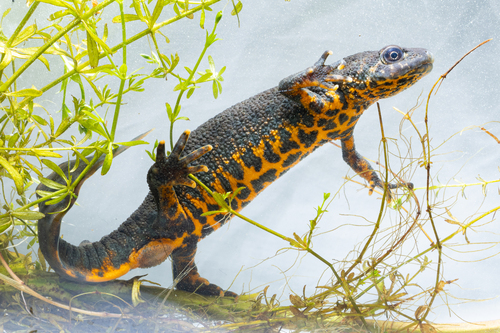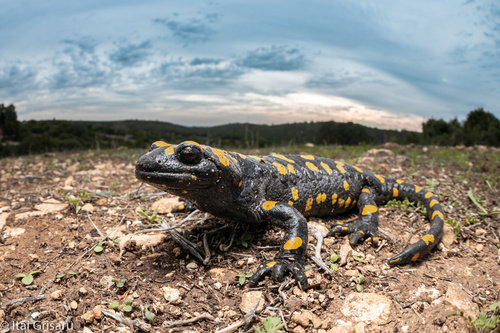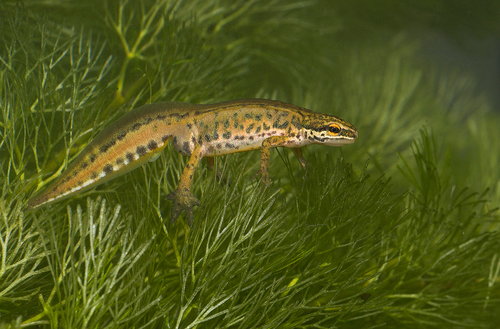
About Lissotriton helveticus (Razoumovsky, 1789)
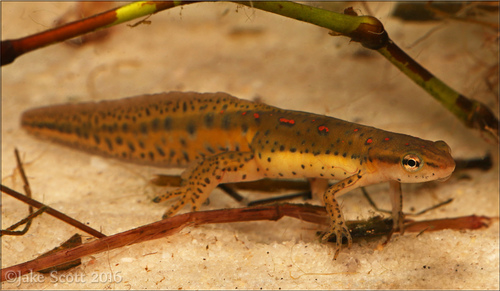
Lissotriton helveticus, commonly known as the palmate newt, has the following physical characteristics: adult males reach a total length of 5–8.5 cm (2.0–3.3 in), while females are slightly larger, growing up to 9.5 cm (3.7 in). The tail is slightly shorter than the snout-vent distance, and the head is longer than it is wide, with three longitudinal grooves on the snout. Both sexes have an olive or brown base color; males and some females have dark spotting on the back. In females, these spots may occasionally form two irregular lines, and terrestrial females sometimes have a red stripe running along the back. Both sexes have a dark stripe running across the head through the eyes. The underside is yellow or pale orange, fading to a whiter shade on the sides; the belly may have some dark spots, but the throat is always unspotted. When living on land, the newt's skin is dry and velvety, becoming smooth after it migrates into water. Males can be distinguished from females by their larger, darker-colored cloaca. During the aquatic breeding season, the male's cloaca swells, and other secondary sexual traits develop: males grow a low, smooth skin crest along the back that is higher on the tail. Their tail ends in a blunt tip with a distinct 4–7 mm long filament. Dorso-lateral ridges run along their sides, giving the body an angular, square cross-section, and their hind feet have well-developed dark webbing. The lower half of the tail is blue in breeding males and orange in females. Development of the breeding traits—crest, tail filament, side ridges and webbing—can be suppressed when the newts' natural predators are present. When exposed to predatory goldfish, newts do not develop these traits, because large sexual ornaments would make them more visible as prey. Females do not develop a crest, tail filament, or webbed feet. Palmate newts are sometimes confused with smooth newts (Lissotriton vulgaris), which share most of the same range, but palmate newts can be identified by their unspotted throat. They also resemble Boscá's newt (L. boscai) from the Iberian Peninsula, which only has a single groove on the snout and lacks the dark stripe through the eye. Palmate newts are distributed across Western Europe, ranging from Great Britain, including Scotland, in the north to northern Portugal and Spain in the south. To the east, their range extends to the Elbe River in Germany and the Czech Republic, and the lower and mid Alps in Switzerland. They are most common at elevations between 500–1,500 m (1,600–4,900 ft), but can be found from sea level up to 2,500 m (8,200 ft) in the Pyrenees. Genetic analyses conducted by Recuero and García-París suggest the species was restricted to the Iberian Peninsula during the Last Glacial Maximum, then expanded its range north of the Pyrenees after the ice age. Populations were recently discovered in southwestern Ireland, but it is not yet clear if they are native or introduced to the area. The species is common across most of its range, and inhabits a variety of habitats including forests, marshes, and pastures. It is less abundant in cultivated areas, but can adapt to living in gardens. For reproduction, palmate newts use a variety of stagnant water bodies, and prefer fish-free, acidic ponds. While smooth newts have a similar overall distribution, in France smooth newts tend to prefer ponds in open land, while palmate newts prefer forest ponds. Hybrids between the two species are rare. The reproductive period of palmate newts usually runs from February to May, but can start earlier or last longer in the southern part of the Iberian Peninsula, depending on elevation. To find breeding ponds, newts use magnetoreception for long-distance navigation, and detect frog calls to locate ponds over shorter distances. Once in the water, they are active both day and night. Breeding follows a ritualized courtship display similar to that of other closely related newts: the male attempts to attract a female by swimming in front of her and sniffing her cloaca. He then vibrates his tail against his body, sometimes lashing it less violently than smooth newts do, to fan pheromones toward her. In the final stage, he deposits a packet of sperm called a spermatophore, then guides the female over it so she can pick it up with her cloaca. Females lay between 150 to 440 eggs individually, attaching each to the leaves of aquatic plants. The eggs are 1.3–1.8 mm in diameter, or 2.2–3 mm including the egg capsule, and are very similar to the eggs of the smooth newt. Larvae hatch after 8 to 21 days, depending on water temperature, and measure 8–14 mm at hatching. Young larvae are yellow-brown with two black stripes, and have two appendages called balancers on the sides of the head that are later resorbed as they develop. Their color becomes more cryptic as they mature, and larvae grow to a total length of 3–4 cm (1.2–1.6 in). Larval development is shaped by environmental conditions: when exposed to chemical cues from predatory dragonfly larvae, palmate newt larvae develop larger heads, larger tails, and darker tail pigmentation. Dragonflies are more likely to prey on larvae that do not develop these changes, which suggests the larger tail improves the newts' ability to escape predators. Larvae metamorphose into land-dwelling juvenile newts called efts after 1.5 to 3.5 months, though some larvae overwinter in water instead of metamorphosing that year. Paedomorphism, where adult newts retain their gills and stay aquatic permanently, also occurs in the species. Efts live on land until they reach sexual maturity in their second or third year. On land, they are mainly active during humid nights. Palmate newts usually hibernate on land, but sometimes hibernate in water; populations in the Iberian Peninsula are often active year-round. Larvae, efts, and adult newts mainly feed on a variety of invertebrates, but cannibalism also occurs, most commonly when larvae prey on eggs. Wild palmate newts can live up to 12 years of age.