About Lissotis hartlaubii (Heuglin, 1863)
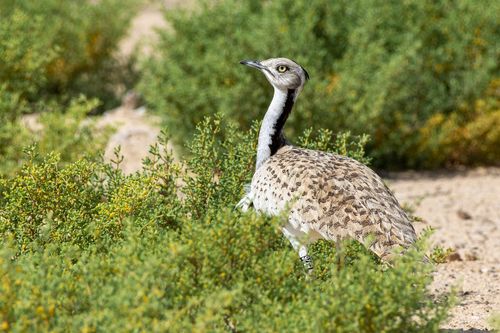
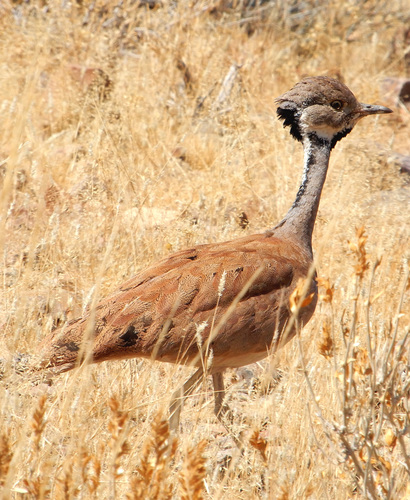
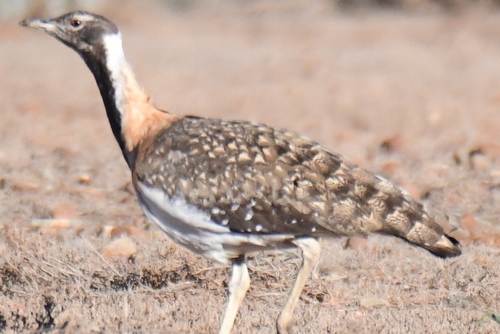
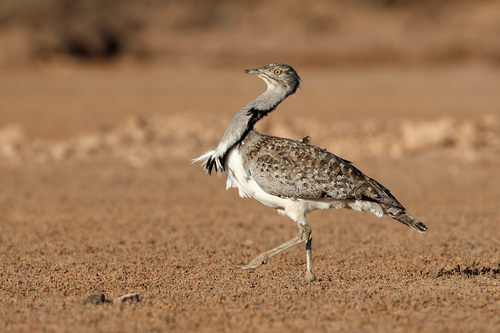
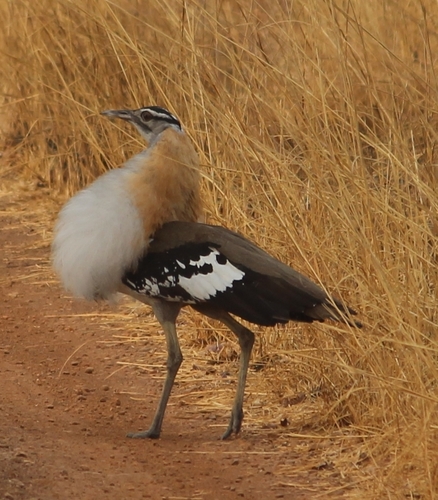
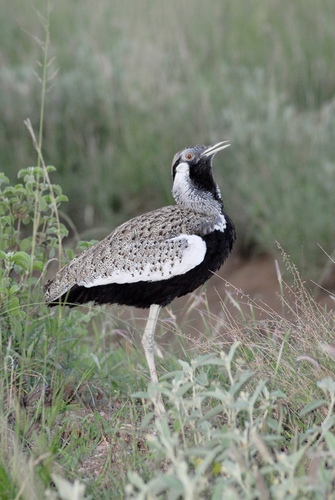
A mature Hartlaub's bustard (scientific name: Lissotis hartlaubii (Heuglin, 1863)) reaches around 60 centimeters (24 inches) in length, with recorded body weights ranging from 1,500 to 1,600 grams (1.5 to 1.6 kilograms). From a distance, individuals cannot be distinguished from the related species L. melanogaster, as their appearance is very similar. Males have an overall grayish coloration, with a more distinct black stripe on the face, plus a black stripe that runs down the neck and connects to the black belly. This species has a small head placed on a long neck, a bulky body, and large legs. Females have a similar overall appearance to males, but their head and hind neck are cream-colored with dark brown markings, their belly is whitish, and their tail is paler. When in flight, Hartlaub's bustard displays less black in the wings, and has a black rump.
Hartlaub's bustard has a relatively restricted range within the Horn of Africa. It is both sedentary and nomadic, and can be found year-round in Ethiopia, southeastern Sudan, eastern South Sudan, northwestern and southern Somalia, northeastern Uganda, northwestern and southern Kenya, and northern Tanzania. In general, the species favors various bushy habitats, including light woodland, thorn country, high scrub, and tall grass cover in dense savanna or on the fringes of water bodies. It can also live in open, tall grassland with scattered Acacia, at elevations up to 1,600 meters (5,200 feet). In Kenya, Hartlaub's bustard occupies lower, drier environments than L. melanogaster, while in Ethiopia, it can be found up to 2,000 meters (6,600 feet) elevation, in Acacia fields and short-grass savanna.
Compared to other bustard species, Hartlaub's bustard uses a contrasting behavioral strategy that is thought to balance improved concealment against the increased risk of ambush. As a smaller bustard species, it is more skilled at rapid take-off when a close-range threat is detected. The species shows moderate sexual size dimorphism, where females are proportionately smaller and lighter than males. Recorded evidence shows that male Hartlaub's bustard performs a distinctive display flight: they ascend steeply to a height of 15 to 20 meters (49 to 66 feet), then glide downward with wings held in a shallow V and legs trailing behind.
Hartlaub's bustard is omnivorous and highly opportunistic in its feeding habits, and eats both animal matter (invertebrates and small vertebrates) and vegetation.