About Lissodelphis borealis (Peale, 1848)
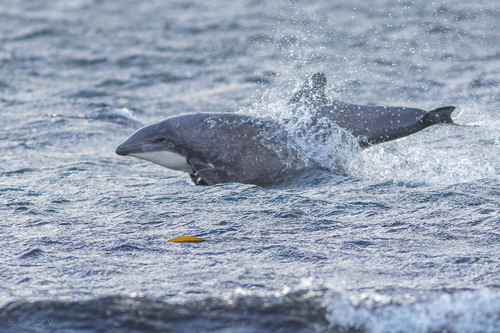
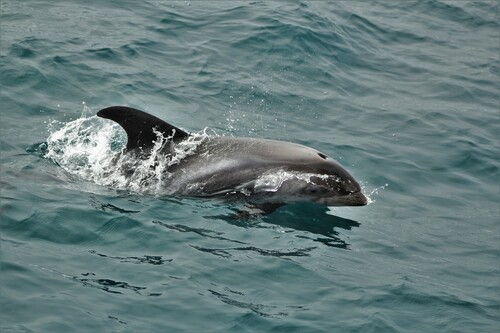
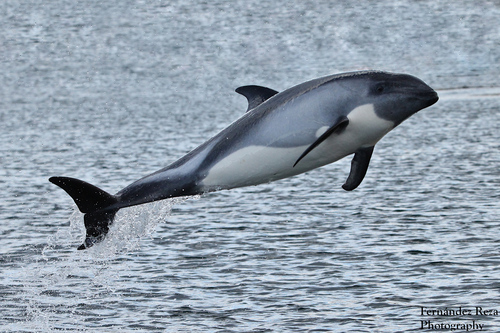
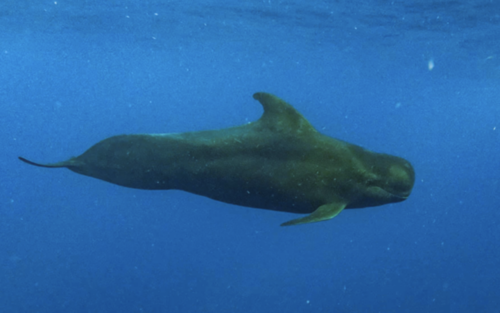
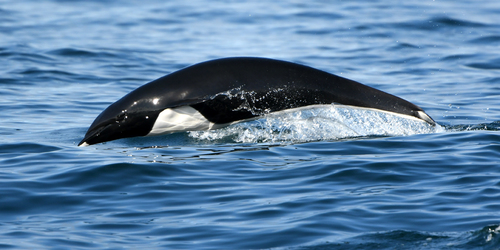
This species is the northern right whale dolphin, with the scientific name Lissodelphis borealis (Peale, 1848). It has a streamlined body with a sloping forehead, and a slimmer build than other delphinids. It has no fin or ridge on its smoothly curving back. Its body is nearly all black, with a white ventral marking that extends forward as a narrow band from the caudal peduncle to the throat region, where the white patch widens. In females, this white band is wider in the genital area than it is in males. By comparison, in the closely related southern right whale dolphin (Lissodelphis peronii), the white patch extends higher on the posterior flanks and head. Newly born calves are initially creamy dark grey or brown, and develop full adult colouring by one year of age. The northern right whale dolphin has a short, well-defined beak, with a straight mouthline. Its flippers are small, curved, narrow and pointed. Its tail flukes are triangular, and like the flippers, are rather pointed. Adult northern right whale dolphins are 2 to 3 meters (6.6 to 9.8 ft) long, and weigh between 60 and 100 kg (130 to 220 lb). Females, with an adult length of 2.3 to 2.6 m, are generally smaller than males, which reach around 3 m. Aside from size and the width difference of the genital white band, the sexes appear similar. Northern right whale dolphins have between 80 and 95 thin, sharp teeth, which are not visible from outside the body, that they use to catch small fish and squid. Northern right whale dolphins have been observed traveling in pods of up to 110 individuals in the eastern North Pacific, and up to 200 individuals in the western North Pacific; larger pods holding as many as 3,000 dolphins have also been reported. This is a gregarious species, and they often associate with Pacific white-sided dolphins (Lagenorhynchus obliquidens). They have also been observed associating with Baird's beaked whales (Berardius bairdii), Dall's porpoises (Phocoenoides dalli), humpback whales (Megaptera novaeangliae), pilot whales (Globicephala macrorhynchus), Risso's dolphins (Grampus griseus) and sperm whales (Physeter macrocephalus), among other cetacean species. Data on the growth and reproduction of northern right whale dolphins is limited. Examinations of individuals caught in driftnets have produced estimates for key life history traits. The average age of sexual maturity is estimated to be 9.9 and 10.1 years for males, and 9.7 and 10.4 years for females. Average body length at sexual maturity is estimated at 215.1 cm and 214.7 cm for males, and 201.1 cm and 199.8 cm for females. The mass of a mature testis ranges between 117.4 g and 1300 g. The gestation period is 12.1 to 12.3 months, and calving peaks during the summer months of July and August. The minimum observed calving interval is two years. Males reach an asymptotic length of 265 cm, while females reach an asymptotic length of 210 cm. Northern right whale dolphins live in cold to temperate waters between 8 to 24 °C (46 to 75 °F) in the North Pacific Ocean. They typically live in offshore, oceanic regions between 34°N to 55°N and 145°W to 118°E. However, L. borealis has been recorded as far south as 29° N, off Baja California, Mexico, during periods of anomalously cold water temperatures. Off the west coast of the United States, northern right whale dolphins are seen primarily in shelf and slope waters. Migration patterns of northern right whale dolphins are not well understood, but aerial surveys off the US coast suggest seasonal changes in density that may reflect seasonal movement. Overall, their distribution appears to shift northward in summer and southward in winter, though contradicting movement patterns have also been observed. Northern right whale dolphins are encountered fairly often by responsible whale watching companies operating off Monterey.