About Lissocarcinus orbicularis Dana, 1852
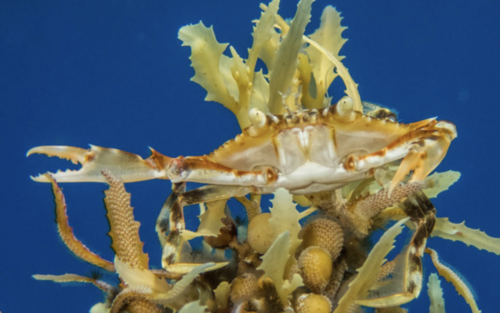
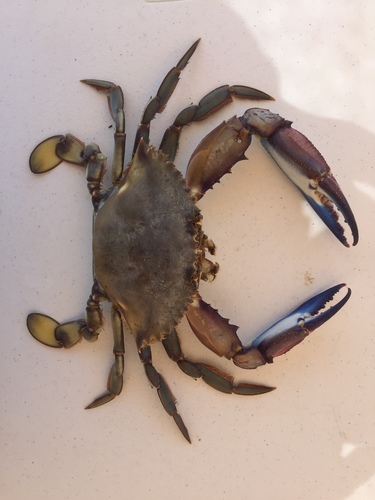
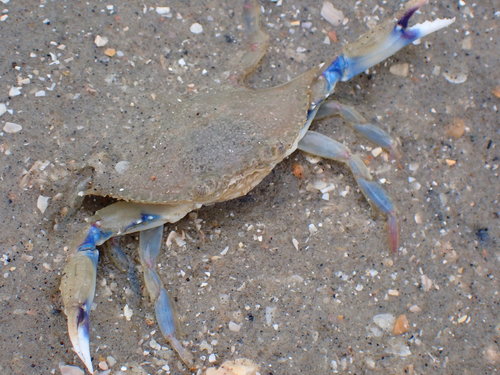
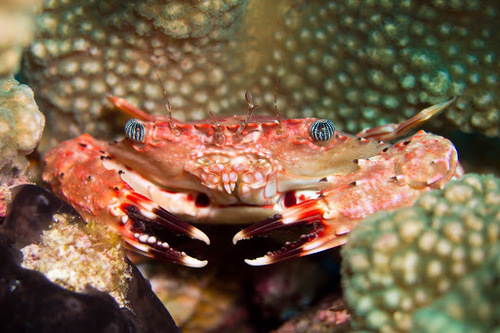
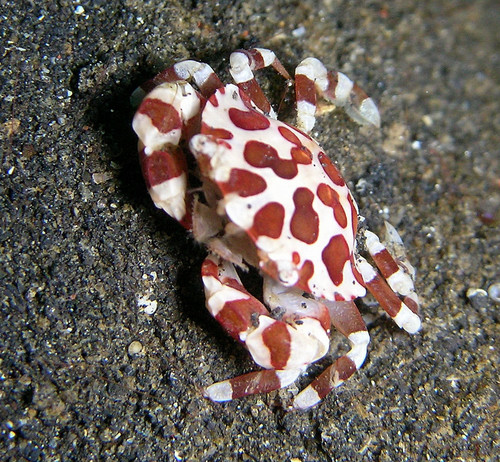
Morphology: Lissocarcinus orbicularis (common name Harlequin crab) grows to around 4 cm (1.6 in) across. It has a smooth, sub-circular carapace that is broader than it is long, with carapace length ranging from 0.3 to 1.4 cm. The carapace has a curved frontal margin with no defined teeth or medial notch, and a highly convex dorsal surface at the center. It can be told apart from L. holothuricola by its generally smoother carapace, and distinguished from other members of the Portunidae family by its distinctive spotted carapace and banded pereiopods (walking legs). The species' color pattern varies between red-brown with white spots and white or yellowish with red-brown spots. Patterning is symmetrically arranged, with spots of different sizes. Individuals from the Celebes Sea have been recorded having spots with a near-black border. Carapace color and patterning change during molting, and the typical background carapace color usually mimics the body color of the crab's host, such as the sea cucumber Thelenota ananas. As decapods, these crabs have ten legs. The first three pairs function in feeding and are called maxillipeds; the remaining pairs are primarily walking legs called pereiopods. The pair of legs with enlarged pincers (chelae) are defined as chelipeds. This species is morphologically adapted to latch onto the outer body covering (integument) of its hosts via hooks on each pereiopod. Its pincer-like claws are rounded, allowing the crabs to attach firmly to their hosts without causing damage. As true crabs belonging to the group Brachyura, L. orbicularis has all five pairs of legs fully visible, and a short abdomen (tail) that is usually hidden beneath the thorax. In true crabs, the abdomen is modified into a simple flap that covers reproductive structures and protects developing eggs. Distribution: The type locality for this species is Fiji. It is widely distributed across shallow waters of the Indo-West Pacific, including Tanzania, Kenya, Somalia, Seychelles, Madagascar, Sri Lanka, Japan, Taiwan, Australia, Hawaii, the eastern coast of South Africa, and the Red Sea. Additional recordings by Nigam and associates from the Zoological Survey of India add the Maldives, Marshall Islands, Palau, Moorea Island (Society Islands), Philippines, Gulf of Tadjoura (Djibouti), Mayotte Island (Comoros Islands), Caroline Islands, New Caledonia, Oman, Papua New Guinea, Vanuatu, Europa Island, Iles Eparses, and most recently India to its known range. In Madagascar, individuals of this species associate with holothuroids (sea cucumbers) that live in seagrass beds, at the end of external slopes, on patchy reefs, or on reef flats near external slopes. In India, L. orbicularis has been found associated with echinoderms in a large coral reef community, including individuals from the classes Crinoidea, Holothuroidea, and Echinoidea. The first recorded collection of L. orbicularis, and of any member of Portunidae, in Taiwan was made in the 1990s. Thelenota ananas was the first recorded host of Harlequin crabs near a Malaysian island in the northeast Celebes Sea in 2012. Reproduction & Development: Unlike many marine invertebrates, the Harlequin crab has a monogamous mating system. Individuals can be found living on sea cucumbers in heterosexual pairs, or alongside their offspring. This species displays weak sexual dimorphism, in which female crabs are significantly larger than males. The larger size of females allows greater resource and energy allocation for producing offspring. Females have been observed to reproduce year-round, carrying around 500 eggs at a time. For most of the year, females make up the majority of the population. These crabs use internal fertilization, and females brood their eggs until the eggs are ready to hatch into free-swimming, planktonic larvae. In Portunidae species including L. orbicularis, the male carries his prospective female mate while she is in her pre-molt stage. The two remain in close proximity for multiple days, with the female's carapace or sternum in direct contact with the male's sternum, until the female is ready to molt. Mating occurs after the female molts. In many portunid species, the male may continue carrying the female after mating until her new integument has hardened, to further ensure his sperm is properly established. Male Portunidae individuals also often produce sperm plugs that block the female's genital duct to prevent insemination by other competing males and ensure fertilization with his own sperm, though this behavior has not been specifically documented in L. orbicularis. Ecology: Only three of the nine species in the genus Lissocarcinus are known to be obligate symbionts of holothurians. The symbiotic interaction between Harlequin crabs and their sea cucumber hosts is a defining trait of this species. L. orbicularis specifically has a commensal relationship with certain sea cucumbers, and has no known negative effects on its hosts. It can be found on the outer body integument, inside the gut cavity, or near the oral tentacles and anus of sea cucumber species Holothuria whitmaei, Actinopyga obesa, and most commonly Holothuria atra. Sea cucumbers produce cytotoxic secondary metabolites called saponins to repel predators. These saponins also act as kairomones, which are chemical signals that attract symbiotic animals including the Harlequin crab. While these signals usually alert other organisms to the sea cucumber's toxic nature, the Harlequin crab and other symbionts have evolved to recognize saponins as key signals that indicate a potential host. Living on a toxic host may also act as a defense against the Harlequin crab's own predators. In general, the species prefers larger holothuroids across the genera Thelenota, Bohadschia and Holothuria, likely due to these hosts' toxicity levels and corresponding chemical signaling. Usually, only one adult crab or one heterosexual pair occupies a single holothuroid host, though some hosts host multiple individuals consisting of an adult pair and their young. Adult crabs display strong territorial defense against same-sex adults, guarding their host because hosts are typically uncommon and scattered. This species may be mistaken for L. laevis, which shares the same common name. However, L. laevis does not have the same banding pattern on all legs, and it is a common symbiont of sea anemones rather than sea cucumbers.